Fort Richardson

Why it's listed
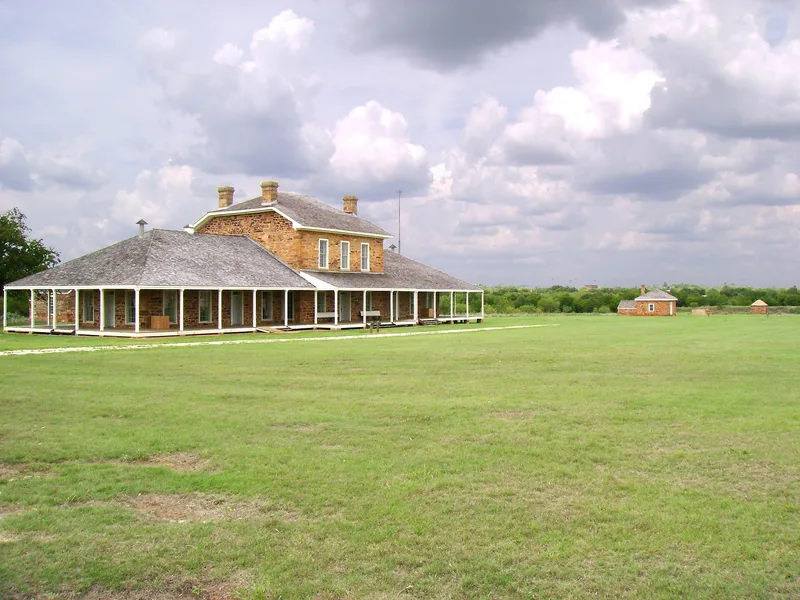
Fort Richardson, on the south edge of Jacksboro, Texas, was founded in 1867 as the northernmost post in the state's chain of frontier forts. It replaced Fort Belknap and guarded the North Texas frontier during the Kiowa-Comanche conflicts after the Civil War. Of more than forty original buildings, only a handful remain: the sandstone hospital, an officers' quarters, the post bakery and the stone powder magazine, among others. Restoration by the Texas Parks and Wildlife Division has returned the hospital porch and repointed its rubble stonework, and the hospital now serves as a museum. The fort's history includes the 1871 pursuit of the raiders behind the Warren wagon train massacre, led by Colonel Ranald Mackenzie, and the Jacksboro trial of Satanta and Big Tree. Troops from the post joined the Red River War of 1874-75. The fort was abandoned in 1878, after the tribes were confined to Oklahoma reservations.
Significance in brief: It was the northernmost of the chain of Texas forts and protected the North Texas frontier during the Kiowa-Comanche conflicts after the Civil War. Troops from the fort took part in the Red River War of 1874-75. The 1871 trial of Kiowa leaders Satanta and Big Tree, held in nearby Jacksboro, was the first trial of Indians in a non-military court.
Machine-generated summary. This summary was generated by a language model from the official nomination document and has not been reviewed line by line by an editor. It may contain errors. Check the source document before relying on any detail. Source: nomination document (PDF) · National Archives catalog entry. NRHP reference 66000816, listed October 15, 1966. Summary generated October 2026 (model claude-sonnet-5-5, prompt v1.0-2026-10-29, confidence medium).
Key facts
| Address | S of Jacksboro on U.S. 281, Jacksboro |
|---|---|
| County | Jack County |
| Listed | October 15, 1966 |
| Reference number | 66000816 |
| Resource type | Building |
| Period of significance | 1867 |
| Areas of significance | Military |
| Level of significance | National |
| National Historic Landmark | Yes, designated November 27, 1963 |
| Status (as stated in the nomination) | Surviving buildings are under restoration by the Texas Parks and Wildlife Division; the hospital is used as a museum and the park is open to the public year-round. Condition is listed as good. |
| Acreage | 42 |
| Coordinates | 33.20816, -98.16507 (NPS GIS) |
What listing means for this property
National Register listing is honorary: it recognises significance and does not restrict what a private owner may do without federal money or permits. It unlocks the 20% federal rehabilitation tax credit for income-producing buildings, state credits in many states, and Section 106 review when federal agencies are involved. See what listing means in practice.
General information, not legal or tax advice. Rules change; confirm with your State Historic Preservation Office or a qualified adviser.
Sources and further reading
- National Park Service, National Register of Historic Places database (snapshot May 2026), reference 66000816.
- Nomination form (PDF, National Archives) — catalog entry
- Wikipedia article (used for cross-checking only; text not reproduced here)
- Wikidata Q5471915
- This listing as JSON
Last updated October 2026. Found an error? See the editorial policy for how to report it.