Monroe-Crook House

Why it's listed
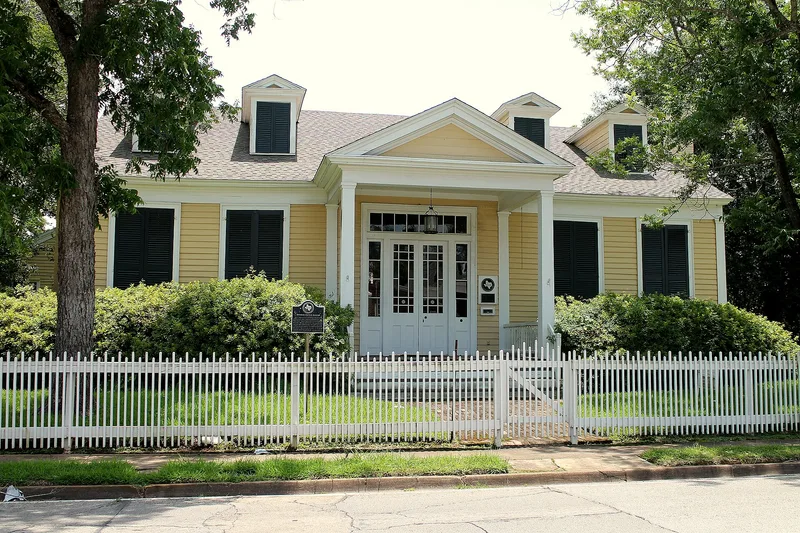
Built in 1854 at 707 East Houston Street in Crockett, this one-and-a-half story frame house is a late Greek Revival town residence. It follows a central hall plan with four twenty-foot-square rooms, each with a fireplace, and fourteen-foot ceilings on the first floor. A pedimented portico with wooden columns shelters the double-door entrance, and four dormers on the north front echo its design. Brick fills the spaces between the wall studs, and a three-window bay was added to the east side in the late nineteenth century. Armistead Thompson Monroe, a merchant who came to Texas in the early 1840s and became one of Crockett's leading businessmen, built the house. His father was a nephew of President James Monroe. Later occupants included the Aldrich family and, from 1911, George W. Crook and his descendants. Crook's daughter provided in her will that the house serve the Houston County community. It was listed for its architecture.
Significance in brief: The nomination cites the house as an example of late Greek Revival architecture in Texas. It is also tied to Armistead Thompson Monroe, a leading Crockett merchant and relative of President James Monroe. A later owner's will provided for its use in the interest of the Houston County community.
Machine-generated summary. This summary was generated by a language model from the official nomination document and has not been reviewed line by line by an editor. It may contain errors. Check the source document before relying on any detail. Source: nomination document (PDF) · National Archives catalog entry. NRHP reference 71000940, listed March 31, 1971. Summary generated October 2026 (model claude-sonnet-5-5, prompt v1.0-2026-10-29, confidence high).
Key facts
| Address | 707 E. Houston St., Crockett |
|---|---|
| County | Houston County |
| Listed | March 31, 1971 |
| Reference number | 71000940 |
| Resource type | Building |
| Period of significance | 19th Century (1854) |
| Architect / builder | Armistead Thompson Monroe (builder) |
| Architectural style | Late Greek Revival |
| Areas of significance | Architecture |
| Level of significance | Local |
| Status (as stated in the nomination) | The form marks the property as occupied and in good condition, and notes it was a Recorded Texas Historic Landmark in 1969. Later grant notes in the file mention exterior and interior restoration. |
| Acreage | 0.7 |
| Coordinates | 31.31916, -95.45445 (NPS GIS) |
What listing means for this property
National Register listing is honorary for a privately owned home: it does not by itself restrict what an owner may do with their own money, and it does not require public access. Restrictions come from local landmark or historic-district ordinances, which are separate (how they differ).
Owner-occupied houses are not eligible for the 20% federal rehabilitation tax credit, which applies to income-producing buildings, but many states offer credits for homeowners. Listing also opens the door to preservation easements and to buying a plaque. Start with what listing means for homeowners, renovating a listed house and selling one.
General information, not legal or tax advice. Rules change; confirm with your State Historic Preservation Office or a qualified adviser.
Sources and further reading
- National Park Service, National Register of Historic Places database (snapshot May 2026), reference 71000940.
- Nomination form (PDF, National Archives) — catalog entry
- Wikidata Q107321607
- This listing as JSON
Last updated October 2026. Found an error? See the editorial policy for how to report it.