Gonzales Commercial Historic District
Also known as: See Also:Gonzales County Courthouse; Gonzales County Jail

Why it's listed
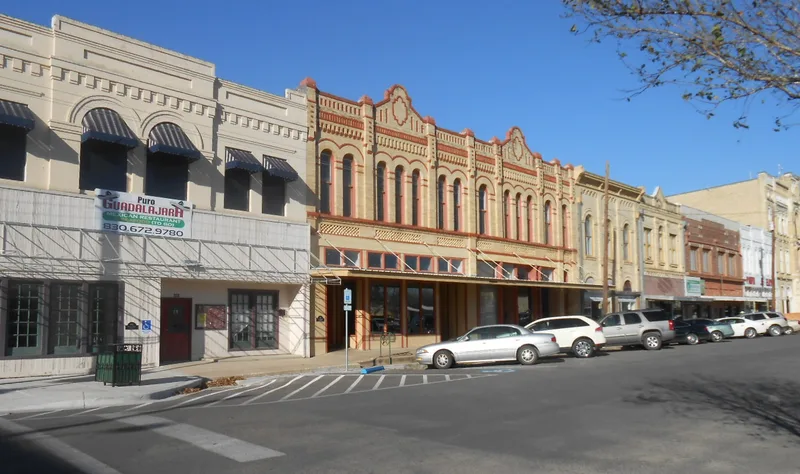
Gonzales Commercial Historic District covers roughly 15 blocks of the Texas county seat, built around public squares laid out in 1825 and platted in 1832 as a giant cross. Commercial rows of one- to three-story masonry buildings surround the squares, most of them one- and two-part commercial blocks with decorated cornices, stepped parapets, three-bay storefronts and suspended canopies. The central squares hold the county courthouse, the jail, three Gothic Revival churches and monuments to Confederate soldiers and to the men who died at the Alamo. A 1909 post office with Prairie School and Classical Revival influences stands just outside the squares. Of 155 properties, 96 contribute to the district, with buildings dating from about 1880 to about 1940. Some storefronts have been altered, and a few churches have modern additions, yet massing, materials and density remain largely intact. The district was listed as the largest and most significant collection of historic commercial and institutional buildings in the county, reflecting the town's growth as a regional trade center.
Significance in brief: The district is described as the largest and most significant collection of historic commercial and institutional buildings in Gonzales County. Its 1832 cruciform plan of public squares, courthouse, jail, churches and monuments shaped the surrounding commercial development during the town's railroad-era growth as a regional trade and government center. It retains a high level of historic integrity, with 1- and 2-part commercial blocks predominating.
Machine-generated summary. This summary was generated by a language model from the official nomination document and has not been reviewed line by line by an editor. It may contain errors. Check the source document before relying on any detail. Source: nomination document (PDF) · National Archives catalog entry. NRHP reference 96000935, listed August 30, 1996. Summary generated October 2026 (model claude-sonnet-5-5, prompt v1.0-2026-10-29, confidence medium).
Key facts
| Address | Roughly bounded by Water, Saint Andrew, Saint Peter, and Saint Matthew Sts., Gonzales |
|---|---|
| County | Gonzales County |
| Listed | August 30, 1996 |
| Reference number | 96000935 |
| Resource type | District |
| Architect / builder | O.H.P. Tudesill (architect, First United Methodist Church, 1900) |
| Architectural style | Late Victorian (Romanesque, Renaissance, Italianate), Classical Revival, Late Gothic Revival, Prairie School, Moderne, and vernacular 1- and 2-part commercial blocks |
| Areas of significance | Architecture, Commerce, Community Planning and Development, Politics/Government |
| Level of significance | Local |
| Status (as stated in the nomination) | Largely in continued commercial, government and religious use; the form lists some vacant resources, and one residence was badly damaged by fire. |
| Acreage | 50 |
| Coordinates | 29.50175, -97.45331 (NPS GIS) |
What listing means for this property
This is a historic district. Buildings within its boundary are either contributing (they add to the district's significance) or non-contributing. Owners of contributing income-producing buildings can claim the 20% federal rehabilitation tax credit; homeowners should look at state credits. National Register districts impose no design review by themselves; a local historic district ordinance, if one exists, does (the difference explained).
General information, not legal or tax advice. Rules change; confirm with your State Historic Preservation Office or a qualified adviser.
Sources and further reading
- National Park Service, National Register of Historic Places database (snapshot May 2026), reference 96000935.
- Nomination form (PDF, National Archives) — catalog entry
- Wikidata Q109999707
- This listing as JSON
Last updated October 2026. Found an error? See the editorial policy for how to report it.