Moore, Col. Hugh B. and Helen, House

Why it's listed
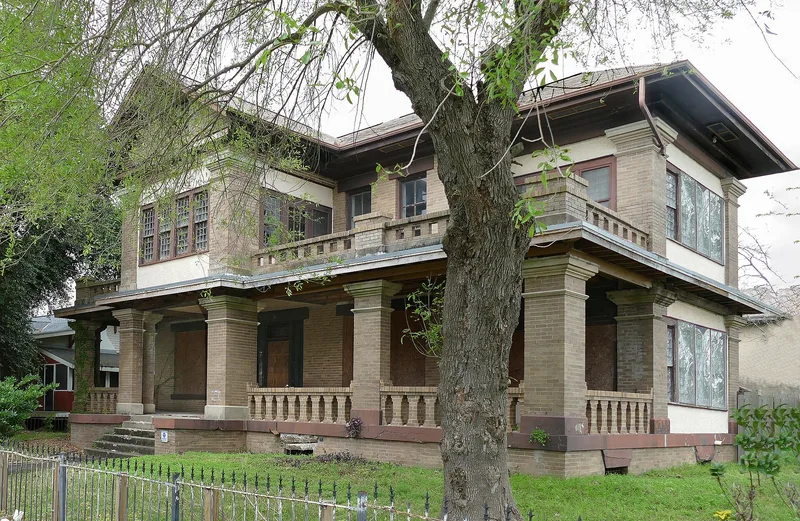
Built in 1912 on the shore of Galveston Bay, this 2 1/2-story brick house in Texas City was home to Colonel Hugh B. Moore and his wife Helen. The James Steward Company of Chicago built it with railroad rails reinforcing the concrete, 14-inch brick walls and no wood in the load-bearing walls. Prairie School influences show in the hipped roof, broad porches and gable-front portico. Stowe and Stowe Architects directed alterations in 1929, including sunroom enclosures. Mahogany woodwork and a six-tier living room fireplace mark the interior. Hugh Moore helped secure harbor funding, recruited industry to Texas City and organized troop and supply transport during the Mexican crisis and World War I. Helen Moore led the suffrage movement, served in the Texas Legislature and presided over the Texas League of Women Voters. A garage apartment and storage building also contribute to the property, which remains a single-family residence.
Significance in brief: The house is tied to Colonel Hugh B. Moore, a transportation expert who helped move U.S. troops during the Mexican crisis and World War I and who promoted Texas City's port and economy. It is also tied to Helen Moore, a suffrage leader, Texas legislator and president of the Texas League of Women Voters. It is further regarded as an excellent local example of residential architecture with Prairie School influences.
Machine-generated summary. This summary was generated by a language model from the official nomination document and has not been reviewed line by line by an editor. It may contain errors. Check the source document before relying on any detail. Source: nomination document (PDF) · National Archives catalog entry. NRHP reference 94001241, listed October 28, 1994. Summary generated October 2026 (model claude-sonnet-5-5, prompt v1.0-2026-10-29, confidence high).
Key facts
| Address | 8 Ninth Ave., N., Texas City |
|---|---|
| County | Galveston County |
| Listed | October 28, 1994 |
| Reference number | 94001241 |
| Resource type | Building |
| Period of significance | 1912-1944 |
| Architect / builder | James Steward Company (Builder, Chicago); Stowe and Stowe (Architects, Galveston) |
| Architectural style | Late 19th and Early 20th Century American Movements: Prairie School |
| Criteria |
|
| Areas of significance | Politics/Government, Community Planning and Development, Military, Architecture |
| Level of significance | State |
| Status (as stated in the nomination) | Currently in use as a single dwelling. It stood vacant for a number of years after the Moores' deaths, before a 1967 purchase and renovation. |
| Acreage | 0.9 |
| Coordinates | 29.39400, -94.90293 (NPS GIS) |
What listing means for this property
National Register listing is honorary for a privately owned home: it does not by itself restrict what an owner may do with their own money, and it does not require public access. Restrictions come from local landmark or historic-district ordinances, which are separate (how they differ).
Owner-occupied houses are not eligible for the 20% federal rehabilitation tax credit, which applies to income-producing buildings, but many states offer credits for homeowners. Listing also opens the door to preservation easements and to buying a plaque. Start with what listing means for homeowners, renovating a listed house and selling one.
General information, not legal or tax advice. Rules change; confirm with your State Historic Preservation Office or a qualified adviser.
Sources and further reading
- National Park Service, National Register of Historic Places database (snapshot May 2026), reference 94001241.
- Nomination form (PDF, National Archives) — catalog entry
- Wikidata Q110002060
- This listing as JSON
Last updated October 2026. Found an error? See the editorial policy for how to report it.