Waxahachie Lumber Company

Why it's listed
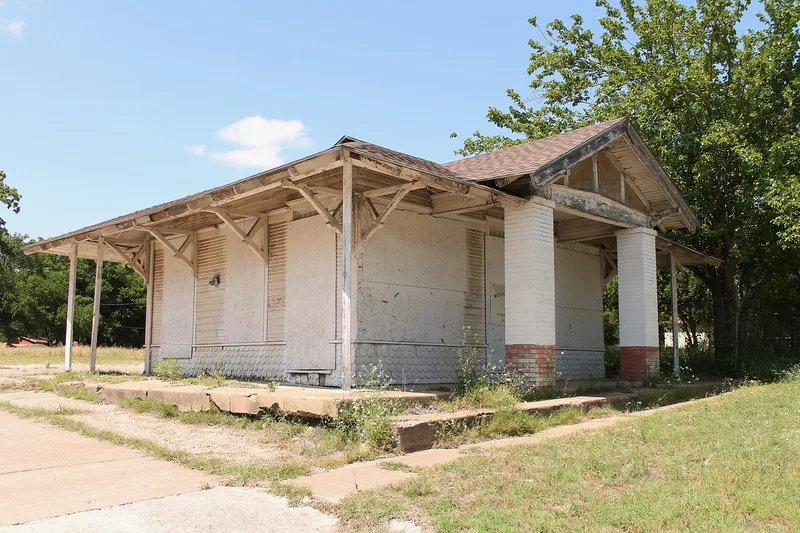
This lumberyard at 123 Kaufman in Waxahachie consists of five frame buildings beside the railroad tracks, east of the downtown core. The site has housed the city's oldest lumber business since about 1880. The business began as a branch of a Houston firm, later became the William F. Lewis Lumberyard, then the Waxahachie Lumber Company, and finally the Rockwell Lumber Company, which operated until the 1970s. Four buildings, including two lumber sheds, an early office used as a warehouse, and a store with a boomtown parapet, keep their nineteenth-century appearance. The fifth, an office built about 1914, adapts the bungalow form to commercial use, with wide overhanging eaves, triangular braces and brick piers running from gable to ground. The yard supplied materials for many notable buildings during the city's most prosperous years, from the arrival of the railroad in 1887 to about the First World War era, and was a local institution for nearly a century.
Significance in brief: The complex is an unusual survival: four of its five buildings keep their 19th-century appearance, while most lumberyards were remodelled or rebuilt. The youngest building, the office (Building A), is a rare adaptation of the Bungaloid style for commercial use. The yard supplied lumber for many significant buildings during the city's most prosperous period.
Machine-generated summary. This summary was generated by a language model from the official nomination document and has not been reviewed line by line by an editor. It may contain errors. Check the source document before relying on any detail. Source: nomination document (PDF) · National Archives catalog entry. NRHP reference 86002424, listed September 11, 1987. Summary generated October 2026 (model claude-sonnet-5-5, prompt v1.0-2026-10-29, confidence medium).
Key facts
| Address | 123 Kaufman, Waxahachie |
|---|---|
| County | Ellis County |
| Listed | September 11, 1987 |
| Reference number | 86002424 |
| Resource type | Building |
| Period of significance | 1885 - c. 1930 |
| Architectural style | Bungaloid style (Building A, the office) |
| Criteria |
|
| Areas of significance | Commerce, Architecture |
| Level of significance | Local |
| Status (as stated in the nomination) | Present use listed as vacant, condition fair, in the 1985 inventory form; the lumberyard closed in the 1970s. |
| Acreage | 1 |
| Coordinates | 32.38597, -96.84378 (NPS GIS) |
What listing means for this property
For an income-producing building, listing (individually or as a contributing building in a district) is the gateway to the 20% federal rehabilitation tax credit on qualified rehabilitation costs, often stackable with state credits. Work claiming the credit must follow the Secretary of the Interior's Standards and be approved in advance.
Listing does not restrict a private owner acting without federal money or permits; where federal funding or licensing is involved, Section 106 review applies.
Noted as vacant in the nomination. Nomination documents can be decades old; current status may differ. If you are considering buying an empty listed property, read the due-diligence checklist.
General information, not legal or tax advice. Rules change; confirm with your State Historic Preservation Office or a qualified adviser.
Sources and further reading
- National Park Service, National Register of Historic Places database (snapshot May 2026), reference 86002424.
- Nomination form (PDF, National Archives) — catalog entry
- Wikidata Q110000109
- This listing as JSON
Last updated October 2026. Found an error? See the editorial policy for how to report it.