Comal Power Plant

Why it's listed
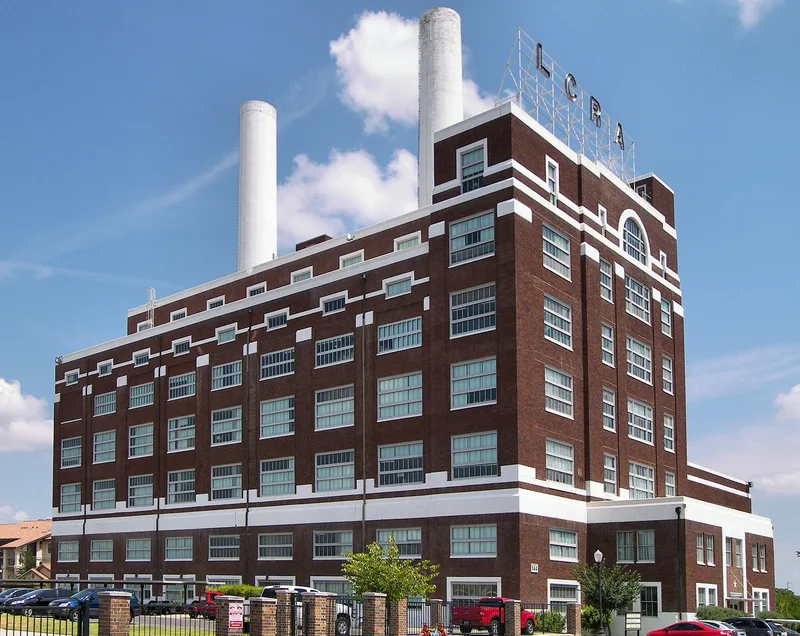
Built in 1926 beside the Comal Canal in New Braunfels, Texas, this former power plant supplied electricity to San Antonio and the surrounding region. The nominated district covers 13.66 acres on the eastern part of the original 32-acre site and includes the main plant building, the canal, a gas metering house, two pump houses, and landscape features such as pecan trees, a circular drive, entry pylons and a suspension footbridge. The main building rises up to seven stories in red brick and white-painted concrete, with Classical Revival details such as pilasters, denticulated window surrounds and a Palladian window motif. Two tall exhaust stacks mark its industrial purpose. The plant was listed for its part in regional electrification between 1925 and 1954, including service to military installations, and for its blend of industrial and classical design. Generating equipment was removed after the plant closed in the 1970s, though two original hoists remain.
Significance in brief: The plant is argued to be locally significant under Criterion A for its role in electrical power generation and the development of Central Texas between 1925 and 1954, including service to San Antonio and nearby military installations. Under Criterion C it is significant for combining industrial function with Classical Revival detailing and a City Beautiful-style landscape.
Machine-generated summary. This summary was generated by a language model from the official nomination document and has not been reviewed line by line by an editor. It may contain errors. Check the source document before relying on any detail. Source: nomination document (PDF) · National Archives catalog entry. NRHP reference 04000895, listed August 20, 2004. Summary generated October 2026 (model claude-sonnet-5-5, prompt v1.0-2026-10-29, confidence medium).
Key facts
| Address | Jct. of Landa Rd. and Landa Park Dr., New Braunfels |
|---|---|
| County | Comal County |
| Listed | August 20, 2004 |
| Reference number | 04000895 |
| Resource type | District |
| Period of significance | 1925-1954 |
| Architect / builder | United Gas Improvement Construction Company (UGI) |
| Architectural style | Late 19th and 20th Century Revivals: Classical Revival |
| Criteria |
|
| Areas of significance | Industry, Community Planning and Development, Architecture |
| Level of significance | Local |
| Status (as stated in the nomination) | Decommissioned in the 1970s; the form lists current function as work in progress (decommissioned facility undergoing rehabilitation). |
| Acreage | 13.7 |
| Coordinates | 29.70894, -98.13363 (NPS GIS) |
What listing means for this property
This is a historic district. Buildings within its boundary are either contributing (they add to the district's significance) or non-contributing. Owners of contributing income-producing buildings can claim the 20% federal rehabilitation tax credit; homeowners should look at state credits. National Register districts impose no design review by themselves; a local historic district ordinance, if one exists, does (the difference explained).
General information, not legal or tax advice. Rules change; confirm with your State Historic Preservation Office or a qualified adviser.
Sources and further reading
- National Park Service, National Register of Historic Places database (snapshot May 2026), reference 04000895.
- Nomination form (PDF, National Archives) — catalog entry
- Wikipedia article (used for cross-checking only; text not reproduced here)
- Wikidata Q15211341
- This listing as JSON
Last updated October 2026. Found an error? See the editorial policy for how to report it.