King William Historic District
Also known as: See Also:Bonham, James Butler, Elementary School
Why it's listed
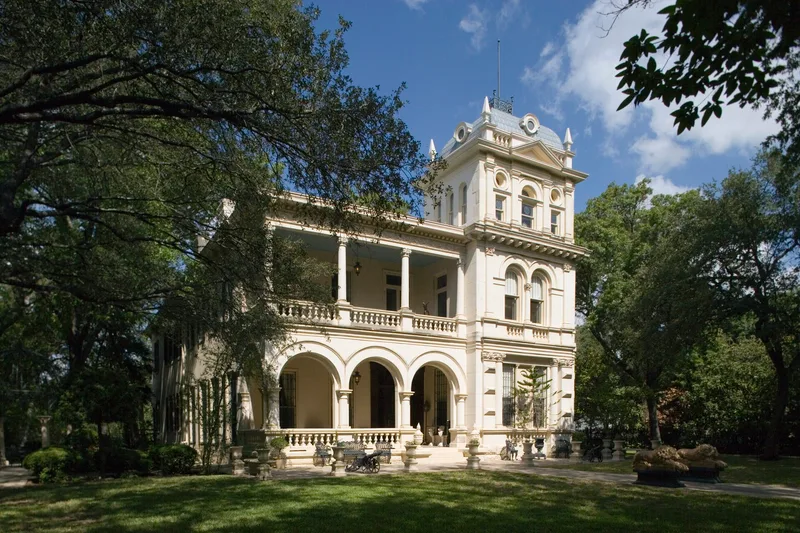
King William Historic District is a neighborhood of Victorian and turn-of-the-century houses beside the San Antonio River, a few blocks south of downtown San Antonio. Large trees, lawns, and picket and iron fences frame rows of houses and mansions, many with Italianate towers, mansard roofs or elaborate scrollwork. The land was once an irrigated farm of Mission Concepcion, later subdivided after passing through several private owners. Carl Guenther, a German miller, established a mill and home there in 1859, and prosperous German merchants, bankers and manufacturers followed, building imposing homes along King William Street. Notable examples include the 1873 Wulff House, the 1880 Groos House, the 1876 Steves Homestead, the Polk Mansion, and the late Greek Revival Oge House, built in 1860 as quarters for the Arsenal's commanding officer. Of fifty structures on King William Street, forty-three contribute to the district's character. The area declined in prestige in the early twentieth century, but restoration began in the late 1960s.
Significance in brief: The nomination holds that the district contains a notable concentration of opulent Victorian houses and mansions with Italianate towers, mansard roofs and fancy scrollwork. It was built up largely by prosperous German businessmen, many following miller Carl Guenther. Of fifty structures on King William Street, forty-three contribute to its nineteenth-century character.
Machine-generated summary. This summary was generated by a language model from the official nomination document and has not been reviewed line by line by an editor. It may contain errors. Check the source document before relying on any detail. Source: nomination document (PDF) · National Archives catalog entry. NRHP reference 72001349, listed January 20, 1972. Summary generated October 2026 (model claude-sonnet-5-5, prompt v1.0-2026-10-29, confidence medium).
Key facts
| Address | Roughly bounded by Durango, Alamo, Guenther Sts. and the San Antonio River, San Antonio |
|---|---|
| County | Bexar County |
| Listed | January 20, 1972 |
| Reference number | 72001349 |
| Resource type | District |
| Period of significance | 19th Century |
| Architectural style | Victorian, including Italianate, Greek Revival and eclectic Renaissance-derived houses |
| Areas of significance | Architecture |
| Level of significance | State |
| Status (as stated in the nomination) | Condition rated good and altered; occupied, mainly private residences and a museum. Restoration had begun by the late 1960s. |
| Acreage | 46 |
| Coordinates | 29.41429, -98.49314 (NPS GIS) |
What listing means for this property
This is a historic district. Buildings within its boundary are either contributing (they add to the district's significance) or non-contributing. Owners of contributing income-producing buildings can claim the 20% federal rehabilitation tax credit; homeowners should look at state credits. National Register districts impose no design review by themselves; a local historic district ordinance, if one exists, does (the difference explained).
General information, not legal or tax advice. Rules change; confirm with your State Historic Preservation Office or a qualified adviser.
Sources and further reading
- National Park Service, National Register of Historic Places database (snapshot May 2026), reference 72001349.
- Nomination form (PDF, National Archives) — catalog entry
- Wikipedia article (used for cross-checking only; text not reproduced here)
- Wikidata Q21527223
- This listing as JSON
Last updated October 2026. Found an error? See the editorial policy for how to report it.