House at 1301 Hill

Why it's listed
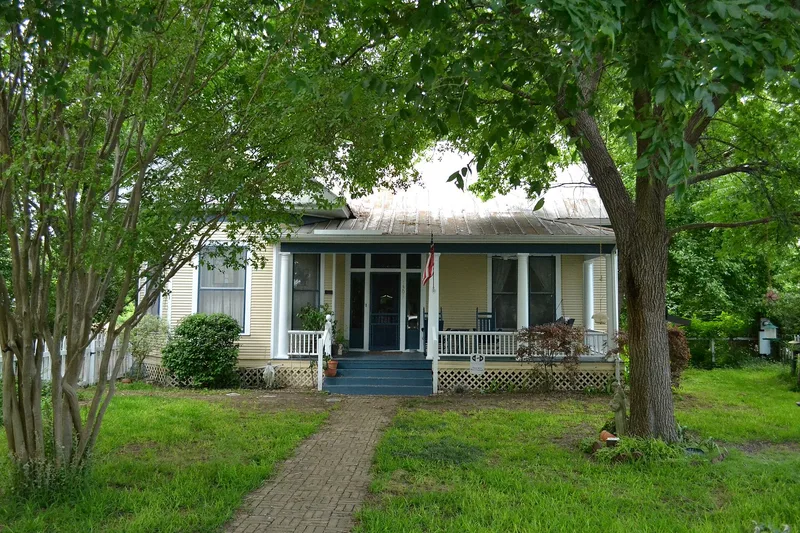
This one-story frame house at 1301 Hill Street in Bastrop dates to about 1910 and reflects late Victorian residential design. It has a hipped roof covered in tin and a projecting bay topped by a pediment, which contains a half-circle vent and wood shingles. The front portico shelters an entrance with sidelights and a transom, and it is supported by Doric columns and finished with a simple balustrade. Lean-to additions have been made at the rear, but the house is recorded in good physical condition. It continues to serve as a residence, the same purpose for which it was built. The property was recorded during a 1976 survey of Bastrop and was judged significant at the local level, mainly as a good surviving example of a late Victorian home in the community. No architect or builder is identified in the record.
Significance in brief: The nomination describes it as a good example of a late Victorian home in Bastrop. It is evaluated as locally significant.
Machine-generated summary. This summary was generated by a language model from the official nomination document and has not been reviewed line by line by an editor. It may contain errors. Check the source document before relying on any detail. Source: nomination document (PDF) · National Archives catalog entry. NRHP reference 78003286, listed December 22, 1978. Summary generated October 2026 (model claude-sonnet-5-5, prompt v1.0-2026-10-29, confidence low).
Key facts
| Address | 1301 Hill, Bastrop |
|---|---|
| County | Bastrop County |
| Listed | December 22, 1978 |
| Reference number | 78003286 |
| Resource type | Building |
| Architectural style | Victorian |
| Areas of significance | Architecture |
| Level of significance | Local |
| Status (as stated in the nomination) | Physical condition is listed as good, with rear lean-tos added; it remains in residential use, the same as its original use. |
| Coordinates | 30.11385, -97.31503 (NPS GIS) |
What listing means for this property
National Register listing is honorary for a privately owned home: it does not by itself restrict what an owner may do with their own money, and it does not require public access. Restrictions come from local landmark or historic-district ordinances, which are separate (how they differ).
Owner-occupied houses are not eligible for the 20% federal rehabilitation tax credit, which applies to income-producing buildings, but many states offer credits for homeowners. Listing also opens the door to preservation easements and to buying a plaque. Start with what listing means for homeowners, renovating a listed house and selling one.
General information, not legal or tax advice. Rules change; confirm with your State Historic Preservation Office or a qualified adviser.
Sources and further reading
- National Park Service, National Register of Historic Places database (snapshot May 2026), reference 78003286.
- Nomination form (PDF, National Archives) — catalog entry
- Wikidata Q110001436
- This listing as JSON
Last updated October 2026. Found an error? See the editorial policy for how to report it.