Red Lion Borough Historic District

Why it's listed
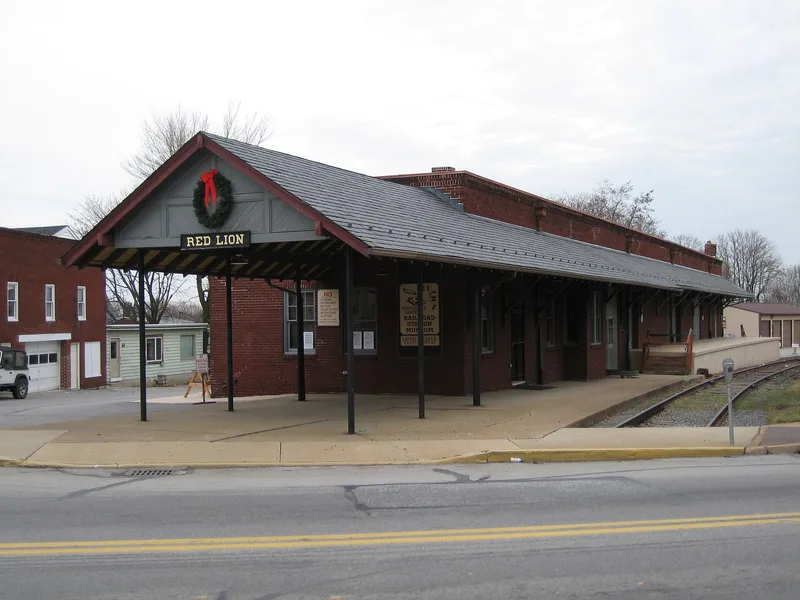
Red Lion Borough's historic district covers about 260 acres in central York County, centered on the crossing of Broadway and Main Streets. Its 1565 buildings are tightly packed on narrow lots, mostly two-story brick or frame structures, and many are attached duplexes or row houses. The town began in 1874 as a stop on the Peach Bottom Railroad, named after Catherine Meyer's tavern, and was incorporated as a borough in 1880. From the 1880s through the 1920s, it became a major center of cigar manufacturing, with dozens of small factories and, by 1927, 86 factories reported. Furniture makers arrived after 1907. The district's buildings, mostly vernacular with decorative elements of popular styles, show that growth in residential, commercial and industrial form. Most date between 1890 and 1930.
Significance in brief: The district is significant under Criterion A for industry and commerce, because the borough grew as a center of cigar making and later furniture manufacturing. It is significant under Criterion C for architecture, as a locally important collection of late 19th to mid 20th century vernacular residential, industrial and commercial buildings. Its growth from a railroad stop to a self-sufficient industrial town is central to the argument.
Machine-generated summary. This summary was generated by a language model from the official nomination document and has not been reviewed line by line by an editor. It may contain errors. Check the source document before relying on any detail. Source: nomination document (PDF) · National Archives catalog entry. NRHP reference 00000847, listed August 10, 2000. Summary generated October 2026 (model claude-haiku-5-5, prompt v1.1-2026-10-29, confidence high).
Key facts
| Address | Roughly bounded by Edgewood Ave., Windsor Twp. line, MD&PA RR., Chestnut Rd., Country Club Rd., and York Twp. line., Red Line |
|---|---|
| County | York County |
| Listed | August 10, 2000 |
| Reference number | 00000847 |
| Resource type | District |
| Period of significance | 1874-1950 |
| Architectural style | Italianate, Queen Anne, Late Victorian, Colonial Revival, Craftsman, Classical Revival |
| Criteria |
|
| Areas of significance | Industry, Commerce, Architecture |
| Level of significance | Local |
| Status (as stated in the nomination) | The document states that the district retains its historic integrity, with few modern intrusions, and that its resources are generally in good condition. |
| Acreage | 260 |
| Coordinates | 39.90131, -76.60977 (NPS GIS) |
What listing means for this property
This is a historic district. Buildings within its boundary are either contributing (they add to the district's significance) or non-contributing. Owners of contributing income-producing buildings can claim the 20% federal rehabilitation tax credit; homeowners should look at state credits. National Register districts impose no design review by themselves; a local historic district ordinance, if one exists, does (the difference explained).
General information, not legal or tax advice. Rules change; confirm with your State Historic Preservation Office or a qualified adviser.
Sources and further reading
- National Park Service, National Register of Historic Places database (snapshot May 2026), reference 00000847.
- Nomination form (PDF, National Archives) — catalog entry
- Wikipedia article (used for cross-checking only; text not reproduced here)
- Wikidata Q7304524
- This listing as JSON
Last updated October 2026. Found an error? See the editorial policy for how to report it.