Warren Historic District

Why it's listed
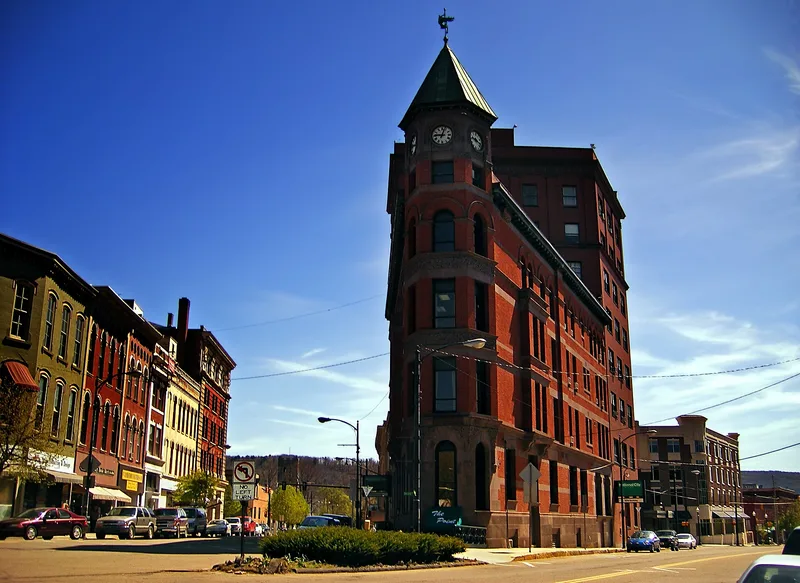
Warren is a city of roughly 11,000 people on the Allegheny River in northwestern Pennsylvania, and its historic district covers the town's original 1795 grid and the streets that grew from it. Surveyors under General William Irvine and Colonel Andrew Ellicott laid out the town that year, with a central square at Market and High Streets, and the first courthouse was built on that square after Warren became county seat in 1819. Early houses from the 1820s and 1830s show Greek Revival detailing, including the 1832 Offerle-Patchen house and the 1830 Jackson-Sill house on Liberty Street. Lumber and then oil brought growth after 1875, when David Beaty struck oil east of the Conewango Creek. Masonry commercial blocks and Victorian houses from that boom define the downtown and surrounding neighborhoods.
Significance in brief: The nomination argues the district is significant for industry and commerce, reflecting the lumber and oil booms of the nineteenth century, and for architecture, with Greek Revival and later Victorian buildings. It also cites the town's 1795 layout and its role as county seat as reasons for significance under government. The district contains 595 contributing resources, about 94% of the total.
Machine-generated summary. This summary was generated by a language model from the official nomination document and has not been reviewed line by line by an editor. It may contain errors. Check the source document before relying on any detail. Source: nomination document (PDF) · National Archives catalog entry. NRHP reference 99000877, listed July 22, 1999. Summary generated October 2026 (model claude-haiku-5-5, prompt v1.1-2026-10-29, confidence medium).
Key facts
| Address | Roughly bounded by Comewango Cr., the Allegheny R., 7th Ave. and Laurel St., Warren |
|---|---|
| County | Warren County |
| Listed | July 22, 1999 |
| Reference number | 99000877 |
| Resource type | District |
| Period of significance | 1820-1945 |
| Architect / builder | Phillips, Edward Albert; Wetmore, Charles D.; Bell, William; Albert Joseph Bodker, Inc.; Beebe, M.E.; Warren & Wetmore; Marston, Charles; Gruninger, Frank |
| Architectural style | Greek Revival; Italianate; Second Empire; Queen Anne; Colonial Revival; Four-Square; Bungalow/Craftsman |
| Criteria |
|
| Areas of significance | Architecture, Industry, Commerce, Politics/Government |
| Level of significance | State |
| Acreage | 441 |
| Coordinates | 41.85278, -79.14702 (NPS GIS) |
What listing means for this property
This is a historic district. Buildings within its boundary are either contributing (they add to the district's significance) or non-contributing. Owners of contributing income-producing buildings can claim the 20% federal rehabilitation tax credit; homeowners should look at state credits. National Register districts impose no design review by themselves; a local historic district ordinance, if one exists, does (the difference explained).
General information, not legal or tax advice. Rules change; confirm with your State Historic Preservation Office or a qualified adviser.
Sources and further reading
- National Park Service, National Register of Historic Places database (snapshot May 2026), reference 99000877.
- Nomination form (PDF, National Archives) — catalog entry
- Wikipedia article (used for cross-checking only; text not reproduced here)
- Wikidata Q7970270
- This listing as JSON
Last updated October 2026. Found an error? See the editorial policy for how to report it.