U.S.S. OLYMPIA

Why it's listed
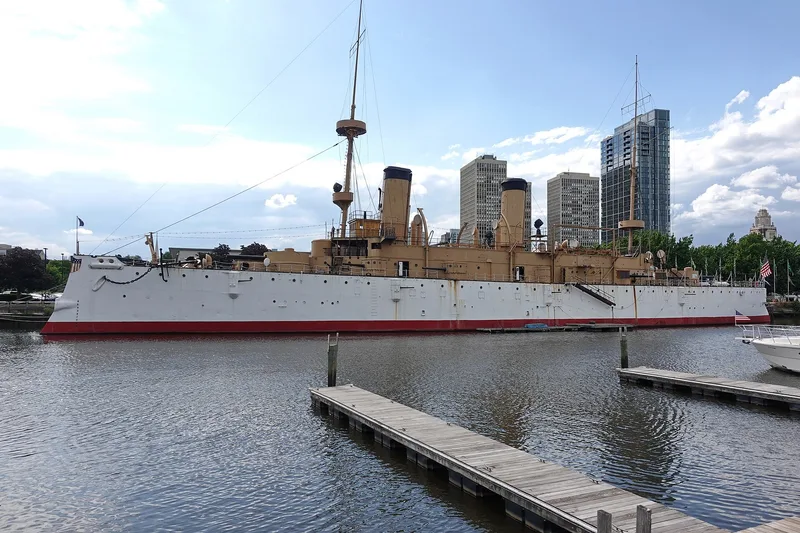
Built by the Union Iron Works of San Francisco between 1890 and 1893, the U.S.S. Olympia was the largest of four protected cruisers authorized by Congress in 1888. Commissioned in 1895, she carried four eight-inch guns in a pair of cylindrical armored turrets and reached 21.7 knots on her trial run, faster than any previous U.S. cruiser. In 1898 she served as Commodore George Dewey's flagship. On May 1 of that year, with Captain Charles V. Gridley commanding, she led the American squadron into Manila Bay and helped destroy the Spanish fleet, a victory that marked the emergence of the United States as a naval power. Later service included Caribbean duty, midshipman cruises, and in 1921 the transport of the Unknown Soldier's body. She was decommissioned in 1922, and after a 1955 acquisition by private groups she was restored and moored at Philadelphia, where she is preserved as the oldest surviving steel-hulled ship of the U.S. Navy.
Significance in brief: The nomination argues the ship is significant as Commodore George Dewey's flagship, which led the Asiatic Squadron to victory over the Spanish fleet in Manila Bay on May 1, 1898. It is also described as the oldest surviving steel ship of the U.S. Navy and the last of the Great White Fleet.
Machine-generated summary. This summary was generated by a language model from the official nomination document and has not been reviewed line by line by an editor. It may contain errors. Check the source document before relying on any detail. Source: nomination document (PDF) · National Archives catalog entry. NRHP reference 66000692, listed October 15, 1966. Summary generated October 2026 (model claude-haiku-5-5, prompt v1.1-2026-10-29, confidence medium).
Key facts
| Address | Pier 40, at foot of Chestnut St., Philadelphia |
|---|---|
| County | Philadelphia |
| Listed | October 15, 1966 |
| Reference number | 66000692 |
| Resource type | Structure |
| Period of significance | c.1898 |
| Architect / builder | Union Iron Works of San Francisco (builder) |
| Areas of significance | Military |
| Level of significance | National |
| National Historic Landmark | Yes, designated January 29, 1964 |
| Status (as stated in the nomination) | Restored to its 1898 appearance and maintained by the Cruiser Olympia Association; the eight-inch gun turrets removed in 1916 were replaced with facsimiles. |
| Acreage | 0.9 |
| Coordinates | 39.94352, -75.14102 (NPS GIS) |
What listing means for this property
National Register listing is honorary: it recognises significance and does not restrict what a private owner may do without federal money or permits. It unlocks the 20% federal rehabilitation tax credit for income-producing buildings, state credits in many states, and Section 106 review when federal agencies are involved. See what listing means in practice.
General information, not legal or tax advice. Rules change; confirm with your State Historic Preservation Office or a qualified adviser.
Sources and further reading
- National Park Service, National Register of Historic Places database (snapshot May 2026), reference 66000692.
- Nomination form (PDF, National Archives) — catalog entry
- Wikipedia article (used for cross-checking only; text not reproduced here)
- Wikidata Q1917116
- This listing as JSON
Last updated October 2026. Found an error? See the editorial policy for how to report it.