Fair Hill Burial Ground

Why it's listed
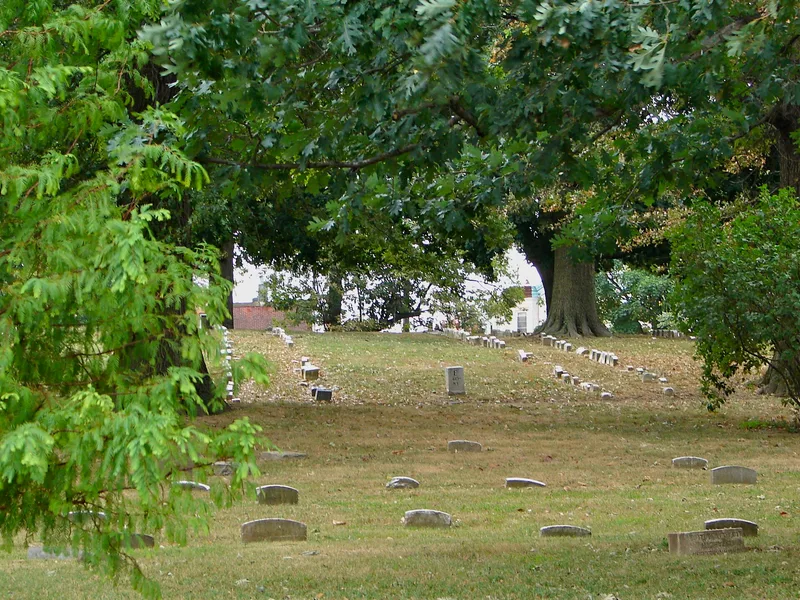
Fair Hill Burial Ground occupies a full city block in North Philadelphia, first used by Hicksite Friends in 1842 and laid out in its present form in 1855. Its small granite and limestone gravestones, set into a gently sloping hill around an oval brick drive, record only names and dates in keeping with Quaker practice. The grounds contain a stone vault built in 1858 to hold bodies over winter until spring burial, and an ornamental iron fence dating to about 1875. The cemetery is best known for its burials of abolitionists and reformers. Lucretia Coffin Mott, a leading antislavery and women's rights figure, is buried here with her husband James Mott, as are Robert Purvis, a founder of the Underground Railroad in Pennsylvania, and his wife Harriet Forten Purvis. Mary Ann McClintock, who attended the 1848 Seneca Falls organizing meeting, and Sarah Pugh, an antislavery leader, are also interred here. The site is valued for these associations with antislavery and women's rights history.
Significance in brief: The nomination argues the burial ground is significant for the many abolitionists, women's rights reformers and antislavery figures buried there, including Lucretia Mott and Robert Purvis. It also cites the cemetery's links to the Underground Railroad and the Seneca Falls women's rights movement, and its place among nineteenth-century Quaker burial grounds in the Philadelphia area.
Machine-generated summary. This summary was generated by a language model from the official nomination document and has not been reviewed line by line by an editor. It may contain errors. Check the source document before relying on any detail. Source: nomination document (PDF) · National Archives catalog entry. NRHP reference 98000900, listed August 7, 1998. Summary generated October 2026 (model claude-haiku-5-5, prompt v1.1-2026-10-29, confidence medium).
Key facts
| Address | Roughly along Germantown, and Indiana Aves., Ninth, and Cambria Sts., Philadelphia |
|---|---|
| County | Philadelphia |
| Listed | August 7, 1998 |
| Reference number | 98000900 |
| Resource type | Site |
| Period of significance | 1842-1907 |
| Architectural style | No style |
| Criteria |
|
| Areas of significance | Black, Social History, Other |
| Level of significance | National |
| Status (as stated in the nomination) | The document states the burial ground retains its integrity, though some grave markers are illegible and some fence sections and sidewalk bricks are missing or replaced. |
| Acreage | 4.5 |
| Coordinates | 39.99671, -75.14605 (NPS GIS) |
What listing means for this property
Sites (archaeological sites, battlefields, landscapes) are often listed with a restricted address to protect them from looting or disturbance. Listing is honorary for private owners; federal undertakings on or near the site go through Section 106 review, and state laws may protect burials and artefacts regardless of listing.
General information, not legal or tax advice. Rules change; confirm with your State Historic Preservation Office or a qualified adviser.
Sources and further reading
- National Park Service, National Register of Historic Places database (snapshot May 2026), reference 98000900.
- Nomination form (PDF, National Archives) — catalog entry
- Wikipedia article (used for cross-checking only; text not reproduced here)
- Wikidata Q4906792
- This listing as JSON
Last updated October 2026. Found an error? See the editorial policy for how to report it.