Colonial Germantown Historic District
Also known as: Germantown; See Also:Cliveden; Independence National Historica

Why it's listed
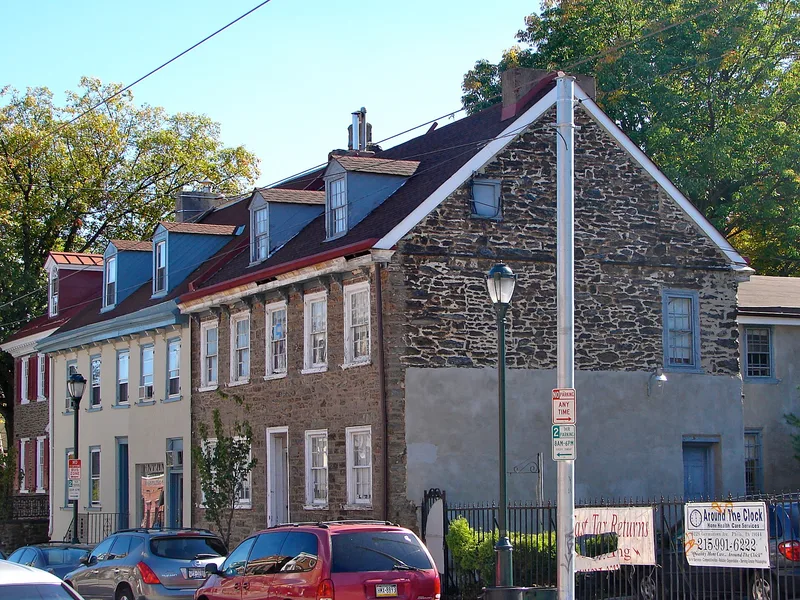
Along Germantown Avenue in northwest Philadelphia, a district of nearly five hundred small-scale commercial and residential buildings runs for twenty-one blocks, mixing Colonial houses with Victorian shops and twentieth-century storefronts. The street grew from a German settlement founded in 1683, whose linen weavers and merchants built houses and workshops along the road. Its early houses are built of Wissahickon schist rubblework, sometimes stuccoed. After the railroad opened in 1832 and horse-car lines followed in 1859, the avenue became a commercial center. Between 1880 and 1910, new railroad and trolley lines drew shoppers to the intersection with Chelten Avenue, where large banks, theatres and department stores were built. The district is significant for documenting this commercial development from its colonial origins through World War II.
Significance in brief: The addendum argues that the nineteenth and early twentieth century commercial buildings are significant alongside the earlier Colonial and Federal houses. It holds that the street represents the development of commerce in Germantown from its founding through incorporation into Philadelphia in 1854 to World War II, and that the commercial district was once the largest outside the city center.
Machine-generated summary. This summary was generated by a language model from the official nomination document and has not been reviewed line by line by an editor. It may contain errors. Check the source document before relying on any detail. Source: nomination document (PDF) · National Archives catalog entry. NRHP reference 66000678, listed October 15, 1966. Summary generated October 2026 (model claude-haiku-5-5, prompt v1.1-2026-10-29, confidence medium).
Key facts
| Address | Germantown Ave. between Windrim Ave. and Upsal St., Philadelphia |
|---|---|
| County | Philadelphia |
| Listed | October 15, 1966 |
| Reference number | 66000678 |
| Resource type | District |
| Period of significance | 1683-1945 |
| Architectural style | Colonial, Federal, Georgian, Italianate, Second Empire, Colonial Revival, Gothic Revival, Richardsonian Romanesque, Art Deco, Moderne |
| Criteria |
|
| Areas of significance | Industry, European, Architecture, Religion |
| Level of significance | National |
| National Historic Landmark | Yes, designated June 23, 1965 |
| Acreage | 113 |
| Within district | Fairmount Park |
| Coordinates | 40.03765, -75.17547 (NPS GIS) |
What listing means for this property
This is a historic district. Buildings within its boundary are either contributing (they add to the district's significance) or non-contributing. Owners of contributing income-producing buildings can claim the 20% federal rehabilitation tax credit; homeowners should look at state credits. National Register districts impose no design review by themselves; a local historic district ordinance, if one exists, does (the difference explained).
General information, not legal or tax advice. Rules change; confirm with your State Historic Preservation Office or a qualified adviser.
Sources and further reading
- National Park Service, National Register of Historic Places database (snapshot May 2026), reference 66000678.
- Nomination form (PDF, National Archives) — catalog entry
- Wikipedia article (used for cross-checking only; text not reproduced here)
- Wikidata Q5148322
- This listing as JSON
Last updated October 2026. Found an error? See the editorial policy for how to report it.