Kuster Mill
Also known as: Custer's Fulling Mill and Skippack Creek Farm

Why it's listed
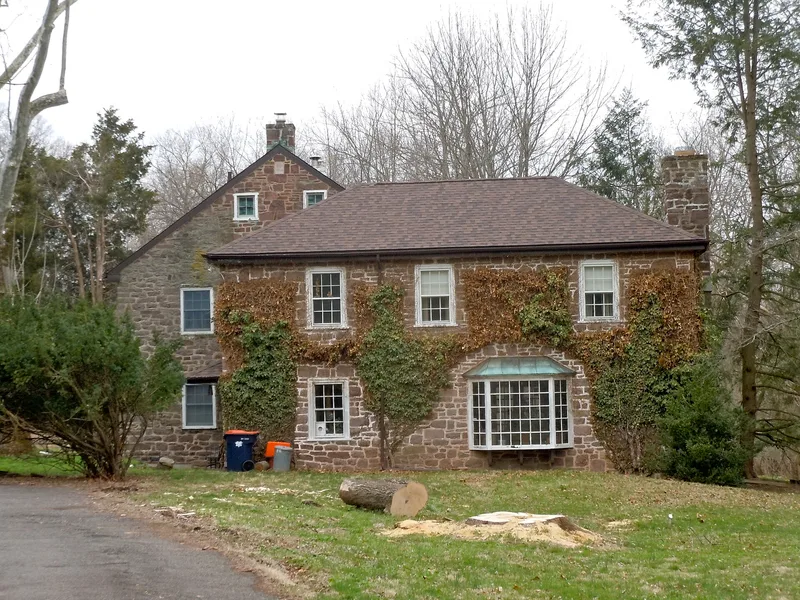
Stone house and fulling mill on Skippack Creek in Collegeville, Montgomery County, Pennsylvania. The original part of the dwelling dates to 1702 and was built of local redbrown stone quarried on the property, with dressed courses across the facade. A datestone bearing 1767 marks an enlargement by John Custer, who is recorded as a fuller in the 1756 Skippack census. The house sits over a spring that supplied water and kept milk and food cool in the cellar. The mill races are stone-lined and intact. A blue dyer's establishment operated alongside the fulling work, and many Skippack landowners of the period were weavers, with many purchasers tracing their origins to Krefeld, a major European textile center. The site's importance lies in its early age, its links to the Kuster family's Germantown stonemasonry, and its role as an early and unusual industrial site in the county.
Significance in brief: The nomination argues the site is significant for its age, its connection with the Kuster family and the Germantown stonemason tradition, and its technological importance as an early and unusual industrial site. It is described as likely the first fulling mill in Montgomery County. The house is said to have had indoor water over a spring.
Machine-generated summary. This summary was generated by a language model from the official nomination document and has not been reviewed line by line by an editor. It may contain errors. Check the source document before relying on any detail. Source: nomination document (PDF) · National Archives catalog entry. NRHP reference 71000711, listed March 24, 1971. Summary generated October 2026 (model claude-haiku-5-5, prompt v1.1-2026-10-29, confidence medium).
Key facts
| Address | On Skippack Creek at Mill Rd. and Water St. Rd., Collegeville |
|---|---|
| County | Montgomery County |
| Listed | March 24, 1971 |
| Reference number | 71000711 |
| Resource type | Building |
| Period of significance | 1702 original part |
| Areas of significance | Industry, Commerce, European, Agriculture |
| Level of significance | National |
| Status (as stated in the nomination) | The fulling mill addition replaced an original that burned in 1936; the form describes the mill races as intact. |
| Acreage | 8 |
| Within district | Evansburg Historic District |
| Coordinates | 40.18825, -75.40889 (NPS GIS) |
What listing means for this property
For an income-producing building, listing (individually or as a contributing building in a district) is the gateway to the 20% federal rehabilitation tax credit on qualified rehabilitation costs, often stackable with state credits. Work claiming the credit must follow the Secretary of the Interior's Standards and be approved in advance.
Listing does not restrict a private owner acting without federal money or permits; where federal funding or licensing is involved, Section 106 review applies.
General information, not legal or tax advice. Rules change; confirm with your State Historic Preservation Office or a qualified adviser.
Sources and further reading
- National Park Service, National Register of Historic Places database (snapshot May 2026), reference 71000711.
- Nomination form (PDF, National Archives) — catalog entry
- Wikipedia article (used for cross-checking only; text not reproduced here)
- Wikidata Q6448171
- This listing as JSON
Last updated October 2026. Found an error? See the editorial policy for how to report it.