Kitson Woolen Mill
Also known as: Holland Thread Company

Why it's listed
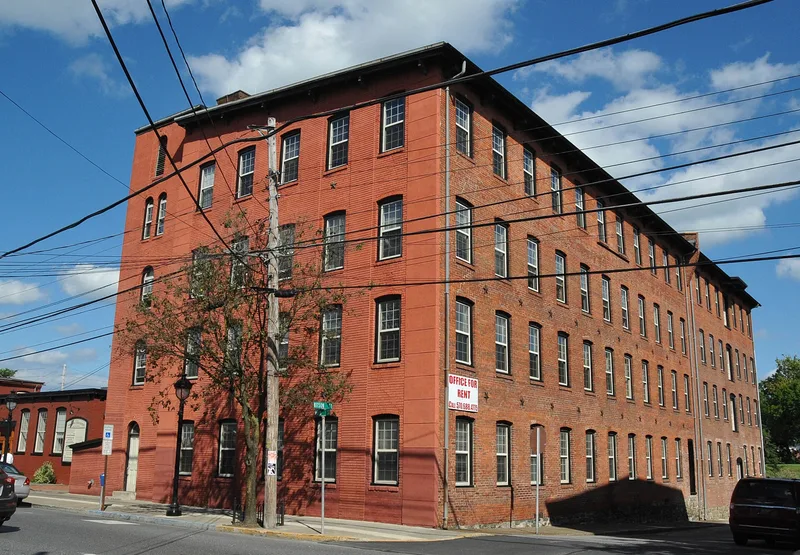
Built largely between 1893 and 1904 on the bank of McMichael's Creek in Stroudsburg, this red brick complex of four principal buildings forms a U open to Main Street. The west wing is four stories with a former bell and stair tower, and the east wing is three stories; both rest on fieldstone and use a mill frame of wooden beams and cast iron caps. Its site has held industry since an 1865 mill, and the present buildings date from the 1893 expansion under Thomas Kitson, whose cornerstone survives on the office. Kitson's firm became the largest textile operation in Monroe County, producing wool cloth sold in New York and reaching about 225 employees during World War I, when it made blankets for troops. It is valued as a well-preserved example of nineteenth-century industrial building. Operations ended with a 1978 strike and rising costs; the buildings have been vacant since.
Significance in brief: The complex is described as the oldest and largest textile mill in Monroe County and as a good example of 19th-century industrial building. Its wool cloth production under Thomas Kitson, its wartime blanket output, and its surviving mill construction are cited as tangible reminders of the county's textile industry.
Machine-generated summary. This summary was generated by a language model from the official nomination document and has not been reviewed line by line by an editor. It may contain errors. Check the source document before relying on any detail. Source: nomination document (PDF) · National Archives catalog entry. NRHP reference 84003501, listed January 12, 1984. Summary generated October 2026 (model claude-haiku-5-5, prompt v1.1-2026-10-29, confidence medium).
Key facts
| Address | 411 Main St., Stroudsburg |
|---|---|
| County | Monroe County |
| Listed | January 12, 1984 |
| Reference number | 84003501 |
| Resource type | Building |
| Period of significance | 1893/1904 |
| Architect / builder | M.L. Phillips (contractor) |
| Areas of significance | Industry |
| Level of significance | Local |
| Status (as stated in the nomination) | Vacant since the mill closed in 1978; adaptive reuse proposed. |
| Acreage | 3.1 |
| Coordinates | 40.98692, -75.18935 (NPS GIS) |
What listing means for this property
For an income-producing building, listing (individually or as a contributing building in a district) is the gateway to the 20% federal rehabilitation tax credit on qualified rehabilitation costs, often stackable with state credits. Work claiming the credit must follow the Secretary of the Interior's Standards and be approved in advance.
Listing does not restrict a private owner acting without federal money or permits; where federal funding or licensing is involved, Section 106 review applies.
Noted as vacant in the nomination. Nomination documents can be decades old; current status may differ. If you are considering buying an empty listed property, read the due-diligence checklist.
General information, not legal or tax advice. Rules change; confirm with your State Historic Preservation Office or a qualified adviser.
Sources and further reading
- National Park Service, National Register of Historic Places database (snapshot May 2026), reference 84003501.
- Nomination form (PDF, National Archives) — catalog entry
- Wikipedia article (used for cross-checking only; text not reproduced here)
- Wikidata Q6418353
- This listing as JSON
Last updated October 2026. Found an error? See the editorial policy for how to report it.