Muncy Historic District
Also known as: See Also:St. James Episcopal Church

Why it's listed
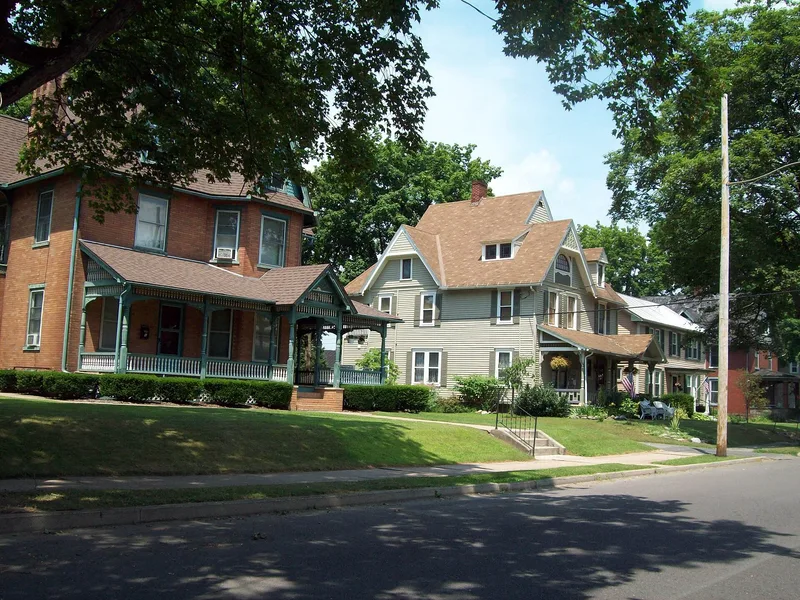
Muncy's historic district covers 151.9 acres in the borough along the West Branch of the Susquehanna River, with 444 buildings laid out on a municipal grid adopted in 1797 using 50-by-180-foot lots. Its buildings date from three main eras, roughly 1790 to 1830, 1840 to 1875 and 1885 to 1905, and they include log and frame houses, brick residences, churches and commercial blocks. Muncy grew into a regional trading center after the West Branch Canal arrived in 1834, and merchants built large houses and commercial buildings in the following decades. The Muncy Female Seminary, founded in 1847, added an educational role to the town. The district is significant for how fully its streetscape preserves this sequence, with only a few dozen intrusions, and for its range of styles, including a Gothic Revival church by Richard Upjohn, St. James Episcopal Church.
Significance in brief: The district is significant for its architecture, which reflects three distinct building eras tied to periods of prosperity in the borough's history. It also reflects Muncy's role as a regional merchant and trade center during the mid-19th century and its later shift to industry.
Machine-generated summary. This summary was generated by a language model from the official nomination document and has not been reviewed line by line by an editor. It may contain errors. Check the source document before relying on any detail. Source: nomination document (PDF) · National Archives catalog entry. NRHP reference 80003570, listed July 3, 1980. Summary generated October 2026 (model claude-haiku-5-5, prompt v1.1-2026-10-29, confidence medium).
Key facts
| Address | Roughly bounded by Ridell Lane, Sherman, Washington and Mechanic Sts., Muncy |
|---|---|
| County | Lycoming County |
| Listed | July 3, 1980 |
| Reference number | 80003570 |
| Resource type | District |
| Period of significance | 1790-1905 |
| Architectural style | Georgian, Federal, Greek Revival, Italianate, Queen Anne, Gothic Revival and Eclectic |
| Areas of significance | Commerce, Transportation, Education, Architecture |
| Level of significance | Local |
| Acreage | 151.9 |
| Coordinates | 41.20461, -76.78468 (NPS GIS) |
What listing means for this property
This is a historic district. Buildings within its boundary are either contributing (they add to the district's significance) or non-contributing. Owners of contributing income-producing buildings can claim the 20% federal rehabilitation tax credit; homeowners should look at state credits. National Register districts impose no design review by themselves; a local historic district ordinance, if one exists, does (the difference explained).
General information, not legal or tax advice. Rules change; confirm with your State Historic Preservation Office or a qualified adviser.
Sources and further reading
- National Park Service, National Register of Historic Places database (snapshot May 2026), reference 80003570.
- Nomination form (PDF, National Archives) — catalog entry
- Wikipedia article (used for cross-checking only; text not reproduced here)
- Wikidata Q6935703
- This listing as JSON
Last updated October 2026. Found an error? See the editorial policy for how to report it.