West End Wheelmen's Club
Also known as: Franklin Club

Why it's listed
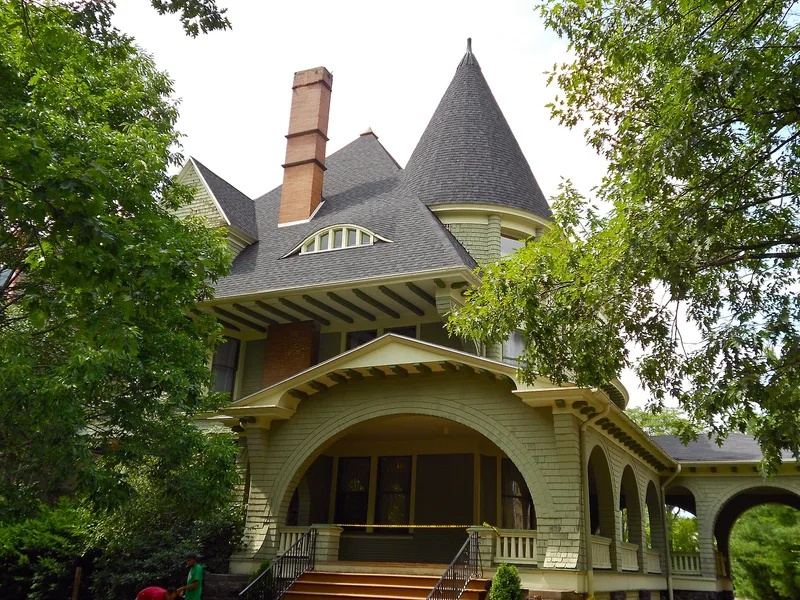
Built in 1897 as a clubhouse for cyclists, this three-story frame building in Wilkes-Barre has a shingled upper floors, a sandstone foundation, a steep pyramidal hip roof and a round tower with a conical roof. Its interior is organized around a three-story open stairwell lit by an art-glass skylight, with a red oak balustrade. The West End Wheelmen, organized in 1889 by six men who mostly worked at the Vulcan Iron Works, used it for races, lantern processions and excursions. After the bicycle craze faded, the building passed to the Franklin Club in 1903, which hosted business networking and civic events, including the planning of the 1906 Giant's Despair Hill Climb. The building is significant for its social history and for its Shingle Style architecture by F. L. Olds, one of the few examples of the style in the city. A 1913 fire and later floods altered parts of the building, but its main interior spaces remain largely intact.
Significance in brief: The building is presented as a local monument to the recreational bicycling craze of the late 1890s and as the long-running home of the West End Wheelmen and their successor clubs, which played a role in the city's civic and social life. Its Shingle Style design by F. L. Olds is also argued to be a strong local example, one of few such buildings in Wilkes-Barre.
Machine-generated summary. This summary was generated by a language model from the official nomination document and has not been reviewed line by line by an editor. It may contain errors. Check the source document before relying on any detail. Source: nomination document (PDF) · National Archives catalog entry. NRHP reference 97000521, listed May 30, 1997. Summary generated October 2026 (model claude-haiku-5-5, prompt v1.1-2026-10-29, confidence high).
Key facts
| Address | 439 S. Franklin St., Wilkes-Barre |
|---|---|
| County | Luzerne County |
| Listed | May 30, 1997 |
| Reference number | 97000521 |
| Resource type | Building |
| Period of significance | ca. 1897-1946 |
| Architect / builder | Frederick L. Olds (architect); William O'Malley (builder) |
| Architectural style | Late Victorian/Shingle Style |
| Criteria |
|
| Areas of significance | Architecture, Social History, Entertainment/Recreation |
| Level of significance | Local |
| Status (as stated in the nomination) | Sold in 1979 to the Knights of Columbus, later sold to a private owner who used it as a banquet facility and nightclub, then acquired by the present owner in 1995; current use beyond that is not stated. |
| Acreage | 0.5 |
| Coordinates | 41.23995, -75.89608 (NPS GIS) |
What listing means for this property
National Register listing is honorary: it recognises significance and does not restrict what a private owner may do without federal money or permits. It unlocks the 20% federal rehabilitation tax credit for income-producing buildings, state credits in many states, and Section 106 review when federal agencies are involved. See what listing means in practice.
General information, not legal or tax advice. Rules change; confirm with your State Historic Preservation Office or a qualified adviser.
Sources and further reading
- National Park Service, National Register of Historic Places database (snapshot May 2026), reference 97000521.
- Nomination form (PDF, National Archives) — catalog entry
- Wikipedia article (used for cross-checking only; text not reproduced here)
- Wikidata Q7985109
- This listing as JSON
Last updated October 2026. Found an error? See the editorial policy for how to report it.