Helfrich's Springs Grist Mill

Why it's listed
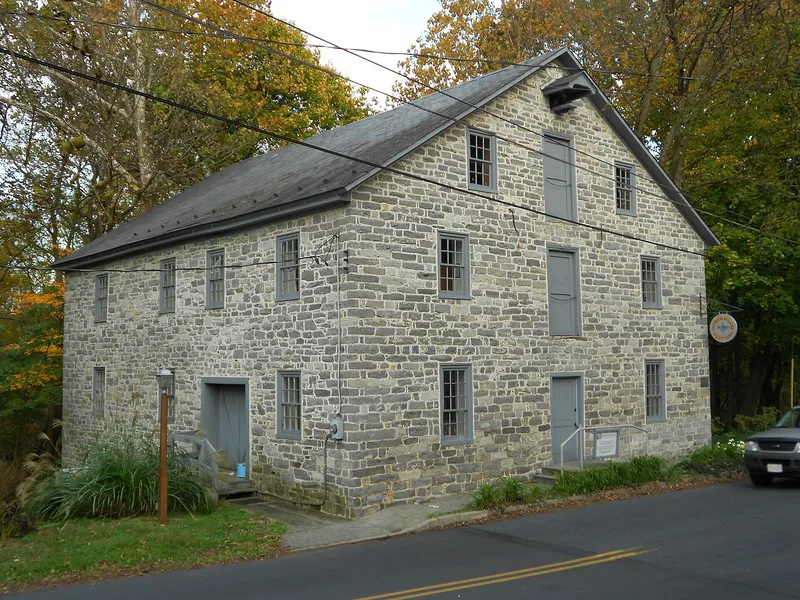
Built in 1807 of local fieldstone on the banks of Jordan Creek, Helfrich's Springs Grist Mill is a two and one-half story gable-roofed building measuring about thirty by fifty-eight feet. A datestone at the corner records the year of construction. The mill replaced an earlier log grist mill built in 1753 by George Hoffman, and Peter Grim erected the present stone structure. Thomas Helfrich bought the mill in 1890 and gave it its name. Its water supply is diverted from the main creek and flows through an original flume beneath a stone arched opening, a feature the nomination describes as unusual in Lehigh County, where mills were usually powered by dammed supply basins. The interior retains heavy oak and chestnut mortise-and-tenon framing, original lime stucco on most stone walls, and wide wooden plank floors. The mill's six-over-six sash windows, arched inlet and surviving framing are regarded as representative of a vanishing regional building type.
Significance in brief: The nomination argues the mill is significant as a typical example of the rapidly disappearing Lehigh County grist mill, with largely intact original masonry, framing, windows and flooring. It also notes that the mill operated directly from a constant flow of spring water without a dam or supply basin, which the nomination describes as unusual in the county.
Machine-generated summary. This summary was generated by a language model from the official nomination document and has not been reviewed line by line by an editor. It may contain errors. Check the source document before relying on any detail. Source: nomination document (PDF) · National Archives catalog entry. NRHP reference 77001174, listed October 14, 1977. Summary generated October 2026 (model claude-haiku-5-5, prompt v1.1-2026-10-29, confidence medium).
Key facts
| Address | W of Fullerton on Mickley Rd., Fullerton |
|---|---|
| County | Lehigh County |
| Listed | October 14, 1977 |
| Reference number | 77001174 |
| Resource type | Building |
| Areas of significance | Industry, Architecture |
| Level of significance | Local |
| Status (as stated in the nomination) | The waterway is still active and flows through the original flume; the original water wheel is no longer present and the mill machinery has been removed. The document says a twentieth-century addition and interior partitions will be removed with the restoration of the mill. |
| Acreage | 0.5 |
| Coordinates | 40.62532, -75.49112 (NPS GIS) |
What listing means for this property
For an income-producing building, listing (individually or as a contributing building in a district) is the gateway to the 20% federal rehabilitation tax credit on qualified rehabilitation costs, often stackable with state credits. Work claiming the credit must follow the Secretary of the Interior's Standards and be approved in advance.
Listing does not restrict a private owner acting without federal money or permits; where federal funding or licensing is involved, Section 106 review applies.
General information, not legal or tax advice. Rules change; confirm with your State Historic Preservation Office or a qualified adviser.
Sources and further reading
- National Park Service, National Register of Historic Places database (snapshot May 2026), reference 77001174.
- Nomination form (PDF, National Archives) — catalog entry
- Wikipedia article (used for cross-checking only; text not reproduced here)
- Wikidata Q5704305
- This listing as JSON
Last updated October 2026. Found an error? See the editorial policy for how to report it.