Stauffer, Dr. B., House

Why it's listed
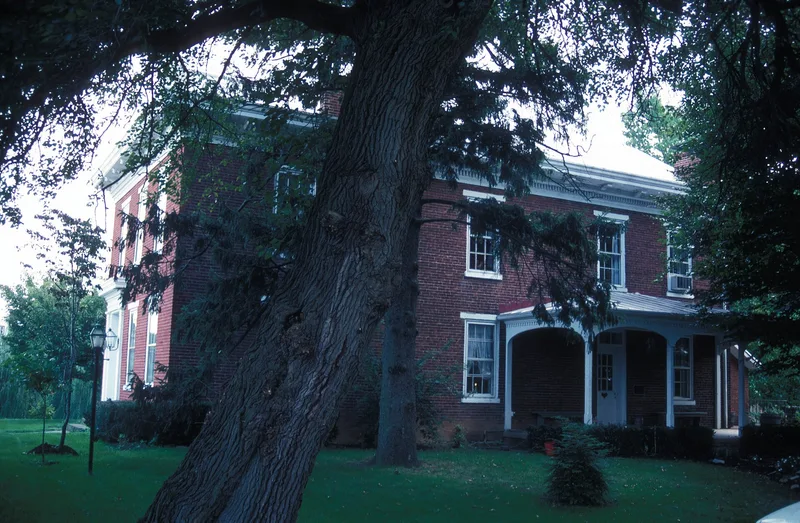
Built in 1848 for Dr. B. Stauffer, a physician who settled in Campbelltown in Lebanon County, this 2½-story brick house has a hipped roof, two brick chimneys, and a flat-roofed dormer over the center bay of the front facade. The boxed cornice is supported by decorative brackets, and the frieze carries dentils and rosettes. Six-over-six windows have plain stone lintels and sills. The main doorway, on the north elevation, has a heavy classical entablature above a panelled door and glass transom. A two-story veranda with Doric columns on the upper story runs along the east side, and a brick smokehouse and beehive oven stand at the rear. Stauffer, born in Mastersonville in 1825 and trained at the University of Pennsylvania, bought twenty acres in 1848 and built a nine-room brick house with an attached apothecary shop. He made his own pills and medicines there and dispensed them to people in surrounding communities. He died in 1911 and is buried at the Reformed Church Cemetery.
Significance in brief: The nomination describes the house as an excellent example of a mid-19th century brick house and cites its local significance as the home of the town doctor. Stauffer practised medicine in Campbelltown and served nearby communities as a druggist from an apothecary shop on the property, which is no longer standing.
Machine-generated summary. This summary was generated by a language model from the official nomination document and has not been reviewed line by line by an editor. It may contain errors. Check the source document before relying on any detail. Source: nomination document (PDF) · National Archives catalog entry. NRHP reference 79002286, listed June 22, 1979. Summary generated October 2026 (model claude-haiku-5-5, prompt v1.1-2026-10-29, confidence medium).
Key facts
| Address | 192 W. Main St., Campbelltown |
|---|---|
| County | Lebanon County |
| Listed | June 22, 1979 |
| Reference number | 79002286 |
| Resource type | Building |
| Architect / builder | Dr. B. Stauffer |
| Areas of significance | Architecture, Social History |
| Level of significance | Local |
| Status (as stated in the nomination) | The apothecary shop is gone now. |
| Acreage | 0.2 |
| Coordinates | 40.27704, -76.59088 (NPS GIS) |
What listing means for this property
National Register listing is honorary for a privately owned home: it does not by itself restrict what an owner may do with their own money, and it does not require public access. Restrictions come from local landmark or historic-district ordinances, which are separate (how they differ).
Owner-occupied houses are not eligible for the 20% federal rehabilitation tax credit, which applies to income-producing buildings, but many states offer credits for homeowners. Listing also opens the door to preservation easements and to buying a plaque. Start with what listing means for homeowners, renovating a listed house and selling one.
General information, not legal or tax advice. Rules change; confirm with your State Historic Preservation Office or a qualified adviser.
Sources and further reading
- National Park Service, National Register of Historic Places database (snapshot May 2026), reference 79002286.
- Nomination form (PDF, National Archives) — catalog entry
- Wikipedia article (used for cross-checking only; text not reproduced here)
- Wikidata Q5303976
- This listing as JSON
Last updated October 2026. Found an error? See the editorial policy for how to report it.