Lancaster Watch Company
Also known as: HMW Industries

Why it's listed
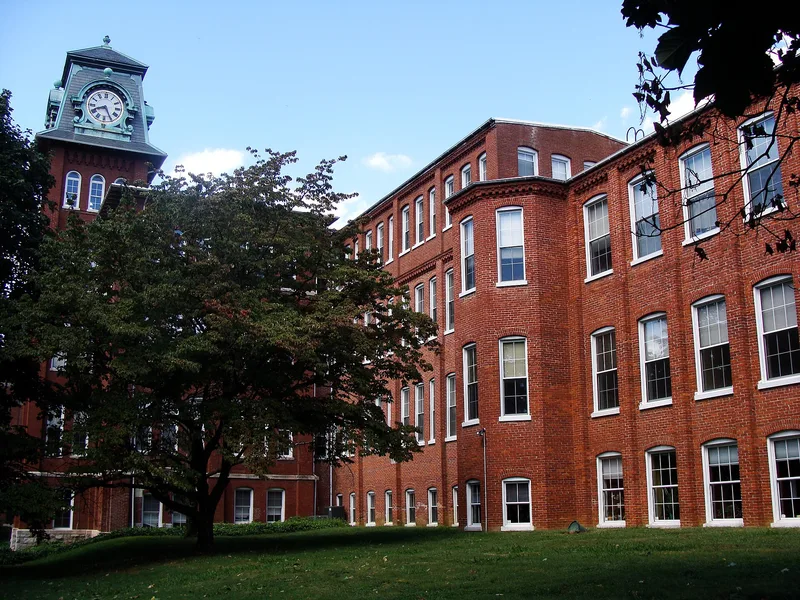
Built between 1874 and 1963 in Lancaster, Pennsylvania, this complex of more than two dozen red brick buildings occupies a single city block bounded by Columbia, West End, Race and Wheatland Avenues. Four stories high with clock towers topped by mansard roofs, its main wings give the plan an E shape. The company began as the Adams and Perry Watch Company in 1874, and by 1877 had produced the first American watch movements with a double escapement. Incorporated as the Hamilton Watch Company in 1892, it became a leading American timekeeper maker, supplying accurate watches to railroad personnel and producing marine chronometers in both world wars. In January 1957 it introduced what the nomination describes as the world's first electric wrist watch. The buildings combine Second Empire, mill and warehouse, Art Deco and International Style features into a unified group, with red brick, regular bays and corbelled cornices tying the later additions to the original 1874 section.
Significance in brief: The nomination argues the complex is significant for its role in American watchmaking and industrial history, including the first large-scale production of several horological inventions and wartime marine chronometers. It also treats the buildings as notable industrial architecture that combines several styles into a unified whole.
Machine-generated summary. This summary was generated by a language model from the official nomination document and has not been reviewed line by line by an editor. It may contain errors. Check the source document before relying on any detail. Source: nomination document (PDF) · National Archives catalog entry. NRHP reference 82003793, listed August 24, 1982. Summary generated October 2026 (model claude-haiku-5-5, prompt v1.1-2026-10-29, confidence medium).
Key facts
| Address | 901 Columbia Ave., Lancaster |
|---|---|
| County | Lancaster County |
| Listed | August 24, 1982 |
| Reference number | 82003793 |
| Resource type | Building |
| Period of significance | 1874-1963 |
| Architect / builder | Many; see Appendix II for the Builder/Architect entries; the 1874 building was designed by C. L. Stiles |
| Architectural style | Mill/warehouse style; Second Empire Style; Art Deco or Moderne; International Style |
| Areas of significance | Industry, Architecture, Invention |
| Level of significance | National |
| Status (as stated in the nomination) | Condition marked excellent and largely unaltered, with the large water tower, an open storage shed and a small guardhouse in the northern part of the complex identified as non-contributing. |
| Acreage | 7.4 |
| Coordinates | 40.03897, -76.33052 (NPS GIS) |
What listing means for this property
For an income-producing building, listing (individually or as a contributing building in a district) is the gateway to the 20% federal rehabilitation tax credit on qualified rehabilitation costs, often stackable with state credits. Work claiming the credit must follow the Secretary of the Interior's Standards and be approved in advance.
Listing does not restrict a private owner acting without federal money or permits; where federal funding or licensing is involved, Section 106 review applies.
General information, not legal or tax advice. Rules change; confirm with your State Historic Preservation Office or a qualified adviser.
Sources and further reading
- National Park Service, National Register of Historic Places database (snapshot May 2026), reference 82003793.
- Nomination form (PDF, National Archives) — catalog entry
- Wikipedia article (used for cross-checking only; text not reproduced here)
- Wikidata Q5645241
- This listing as JSON
Last updated October 2026. Found an error? See the editorial policy for how to report it.