Herr, Hans, House
Also known as: Christian Herr House
Why it's listed
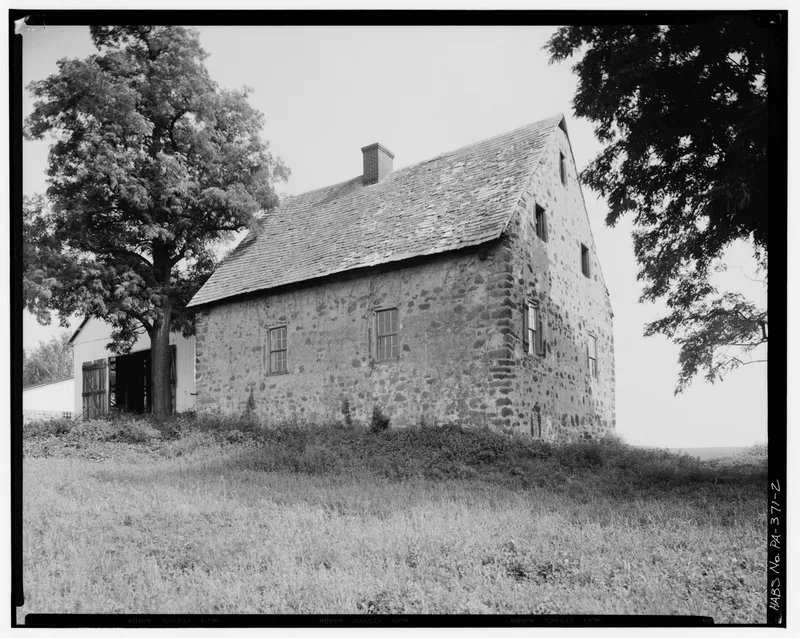
Built of local sandstone in 1719, the Hans Herr House is a one-and-a-half-story dwelling with a stone-vaulted root cellar beneath half of its ground floor. Its plan measures 37 feet 9 inches by 30 feet 10 inches, and the kitchen room contained a large fireplace. The house was built on a tract deeded to Christian Herr by William Penn in 1711. The Herr family, of Swabian descent, had renounced knighthood and war to become nonresistant Waldensians and later Mennonites, and they settled here seeking religious freedom. After the Herrs left, the house served as a place of worship for well over a century, and it is regarded as the oldest Mennonite meeting place in America. Original windows survive in the attic and upper attic, while the ground floor openings were enlarged in the late eighteenth century. The house is also the subject of a painting by the American artist Andrew Wyeth, whose mother was a distant relative of the builder.
Significance in brief: The nomination states the house is the oldest dwelling in Lancaster County and the oldest Mennonite meeting place in America. It is linked to the Herr family, early settlers who came to the county seeking religious toleration, and it was the subject of a painting by Andrew Wyeth.
Machine-generated summary. This summary was generated by a language model from the official nomination document and has not been reviewed line by line by an editor. It may contain errors. Check the source document before relying on any detail. Source: nomination document (PDF) · National Archives catalog entry. NRHP reference 71000708, listed May 3, 1971. Summary generated October 2026 (model claude-haiku-5-5, prompt v1.1-2026-10-29, confidence medium).
Key facts
| Address | 1851 Hans Herr Dr., Lancaster |
|---|---|
| County | Lancaster County |
| Listed | May 3, 1971 |
| Reference number | 71000708 |
| Resource type | Building |
| Criteria |
|
| Areas of significance | Religion, Agriculture |
| Level of significance | National |
| Status (as stated in the nomination) | The house was unoccupied for about a century after its use as a place of worship ended; restoration studies were underway at the time of nomination. |
| Acreage | 1.9 |
| Coordinates | 39.98093, -76.26191 (NPS GIS) |
What listing means for this property
National Register listing is honorary for a privately owned home: it does not by itself restrict what an owner may do with their own money, and it does not require public access. Restrictions come from local landmark or historic-district ordinances, which are separate (how they differ).
Owner-occupied houses are not eligible for the 20% federal rehabilitation tax credit, which applies to income-producing buildings, but many states offer credits for homeowners. Listing also opens the door to preservation easements and to buying a plaque. Start with what listing means for homeowners, renovating a listed house and selling one.
General information, not legal or tax advice. Rules change; confirm with your State Historic Preservation Office or a qualified adviser.
Sources and further reading
- National Park Service, National Register of Historic Places database (snapshot May 2026), reference 71000708.
- Nomination form (PDF, National Archives) — catalog entry
- Wikipedia article (used for cross-checking only; text not reproduced here)
- Wikidata Q5650145
- This listing as JSON
Last updated October 2026. Found an error? See the editorial policy for how to report it.