Furnace Hills Tenant House
Also known as: Foxfire House

Why it's listed
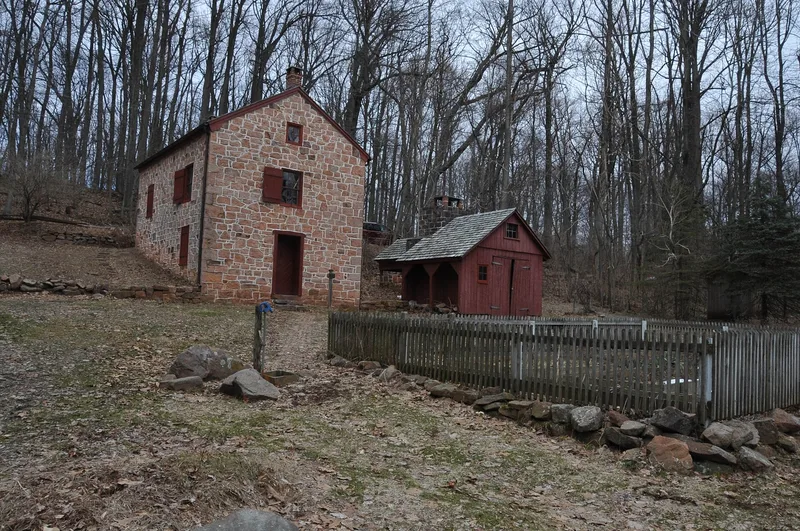
Built of red sandstone into the slope of a ridge, this two-and-a-half-story house in the Furnace Hills of West Cocalico Township dates to roughly 1830 to 1850. Its perpendicular orientation places the kitchen and cold storage in the lower bank level, with the living quarters above, following a European vernacular tradition associated with Swiss Weinbauern houses. The house has an iron ten-plate stove, a root cellar, a parlor and bedroom with peg rails, and a loft with pegged roof framing. Ownership passed through ironmaster Robert Coleman's Elizabeth Furnace estate, then to Abraham Kurtz in 1852, and later to Philip Good and the Bickhart family. The surviving form is rare, with fewer than fifteen perpendicular bank houses of this kind documented in Pennsylvania. The property is significant for its architecture and the survival of its original shell and interior layout, and it is now used by Girl Scouts to teach Pennsylvania German life in the nineteenth century.
Significance in brief: The nomination argues the house is a well-preserved example of the perpendicular bank house type (Swiss Weinbauern) with its traditional division of a lower work level and upper living space. It states that few such houses survive in Pennsylvania and that the form is rare in the region. The house is regarded as locally significant under Criterion C for its architectural design and materials.
Machine-generated summary. This summary was generated by a language model from the official nomination document and has not been reviewed line by line by an editor. It may contain errors. Check the source document before relying on any detail. Source: nomination document (PDF) · National Archives catalog entry. NRHP reference 05000451, listed May 20, 2005. Summary generated October 2026 (model claude-haiku-5-5, prompt v1.1-2026-10-29, confidence medium).
Key facts
| Address | Unpaved Rd approx. 500 ft. E of Project Dr., West Cocalico Township |
|---|---|
| County | Lancaster County |
| Listed | May 20, 2005 |
| Reference number | 05000451 |
| Resource type | Building |
| Period of significance | ca 1830-1850 |
| Architectural style | Pennsylvania German bankhouse; vernacular perpendicular bank house (Swiss Weinbauern type) |
| Criteria |
|
| Areas of significance | Architecture |
| Level of significance | Local |
| Status (as stated in the nomination) | Restored to its original footprint in 1975 after removal of an 1890s frame addition; owned and used by the Penn Laurel Girl Scout Council as a living history site. |
| Acreage | 6 |
| Coordinates | 40.26551, -76.20544 (NPS GIS) |
What listing means for this property
National Register listing is honorary for a privately owned home: it does not by itself restrict what an owner may do with their own money, and it does not require public access. Restrictions come from local landmark or historic-district ordinances, which are separate (how they differ).
Owner-occupied houses are not eligible for the 20% federal rehabilitation tax credit, which applies to income-producing buildings, but many states offer credits for homeowners. Listing also opens the door to preservation easements and to buying a plaque. Start with what listing means for homeowners, renovating a listed house and selling one.
General information, not legal or tax advice. Rules change; confirm with your State Historic Preservation Office or a qualified adviser.
Sources and further reading
- National Park Service, National Register of Historic Places database (snapshot May 2026), reference 05000451.
- Nomination form (PDF, National Archives) — catalog entry
- Wikipedia article (used for cross-checking only; text not reproduced here)
- Wikidata Q5509618
- This listing as JSON
Last updated October 2026. Found an error? See the editorial policy for how to report it.