Davis, David, Farm
Also known as: Summers,Christian,Farm; Martin,John,Farm; 071-14-0021; 071-14-0

Why it's listed
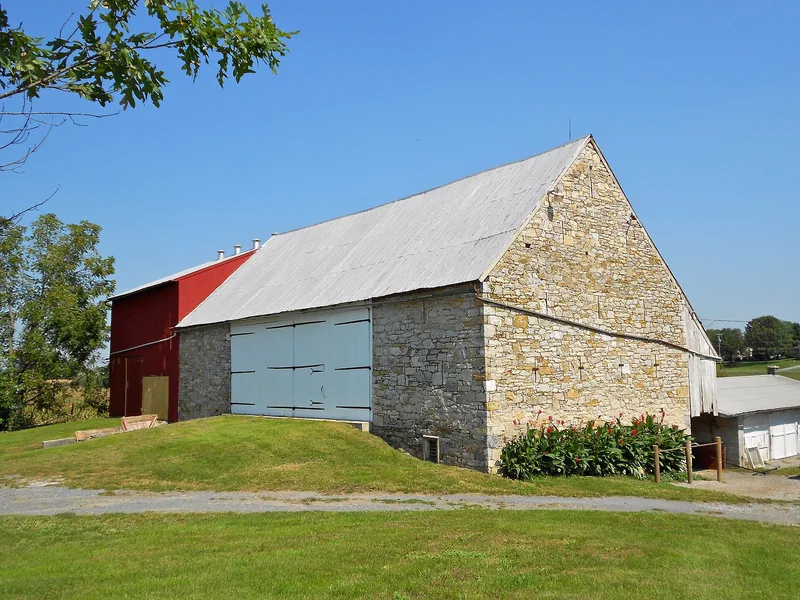
Along a farm lane in the limestone plain of central Lancaster County, the David Davis Farm is a working farmstead whose buildings were added to over more than two centuries. The original two-story stone house dates to about 1750, with a remodeling in 1787 and stone and frame additions from about 1815 to about 1890. The Classic Sweitzer stone bank barn is dated to about 1780, and a stone springhouse to about 1800. The farm was patented to David Davis, a Baptist from Cardiganshire, Wales, and later owned by Amish and Mennonite families, notably the Martins, who held it from 1796 into the twentieth century. Its significance lies in how clearly the layered construction records these successive groups. The family burial ground holds about fifty gravestones within an iron fence.
Significance in brief: The farm is argued to be significant under Criteria A and C as an excellent example of the evolutionary Lancaster County farm, shaped by successive owners of differing cultural groups. The farmhouse is described as a rare surviving vestige of early Welsh settlement, later remodeled by Pennsylvania German owners, and the intact farmstead illustrates both its Welsh origins and later Amish and Mennonite influence.
Machine-generated summary. This summary was generated by a language model from the official nomination document and has not been reviewed line by line by an editor. It may contain errors. Check the source document before relying on any detail. Source: nomination document (PDF) · National Archives catalog entry. NRHP reference 94001060, listed August 30, 1994. Summary generated October 2026 (model claude-haiku-5-5, prompt v1.1-2026-10-29, confidence high).
Key facts
| Address | 737 Spruce Rd., Earl Township, New Holland |
|---|---|
| County | Lancaster County |
| Listed | August 30, 1994 |
| Reference number | 94001060 |
| Resource type | District |
| Period of significance | ca. 1750-1945 |
| Architectural style | Pennsylvania German vernacular; Classic Sweitzer bank barn; restrained vernacular Federal style in the circa 1815 addition |
| Criteria |
|
| Areas of significance | Agriculture, Architecture |
| Level of significance | Local |
| Status (as stated in the nomination) | The farmhouse is in generally good condition and its original portion is undergoing rehabilitation; the barn, springhouse and outbuildings are in good condition. |
| Acreage | 79 |
| Coordinates | 40.12258, -76.07907 (NPS GIS) |
What listing means for this property
This is a historic district. Buildings within its boundary are either contributing (they add to the district's significance) or non-contributing. Owners of contributing income-producing buildings can claim the 20% federal rehabilitation tax credit; homeowners should look at state credits. National Register districts impose no design review by themselves; a local historic district ordinance, if one exists, does (the difference explained).
General information, not legal or tax advice. Rules change; confirm with your State Historic Preservation Office or a qualified adviser.
Sources and further reading
- National Park Service, National Register of Historic Places database (snapshot May 2026), reference 94001060.
- Nomination form (PDF, National Archives) — catalog entry
- Wikipedia article (used for cross-checking only; text not reproduced here)
- Wikidata Q5232865
- This listing as JSON
Last updated October 2026. Found an error? See the editorial policy for how to report it.