Bucher Thal Historic District
Also known as: Bucher Valley Historic District
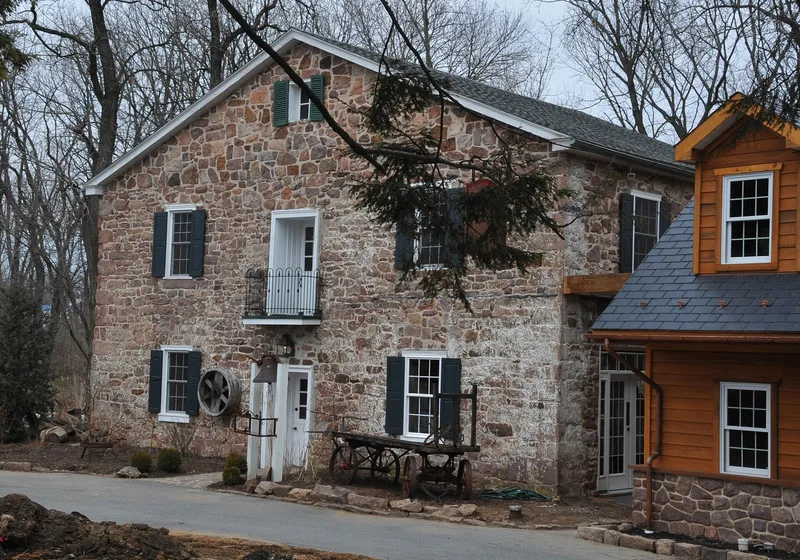

Why it's listed
Bucher Thal is a rural hamlet of twelve buildings and one structure on twenty-nine acres along Weaver Road in East Cocalico Township, Lancaster County, Pennsylvania. It grew up around the grist mill of Michael Bear, and its buildings date from about 1760 to about 1900. The district includes the sandstone Eberly-Lutz House, begun around 1760, and the sandstone Jacob Keller House, built around 1785, both Georgian farmhouses. The brick Samuel Keller House of 1848 is a late Federal farmhouse. The Keller and Lutz barns are sandstone bank barns of the late nineteenth century. Bear's Mill, a sandstone building dating from about 1815, is the centre of the hamlet. The Lutz House incorporates a log cabin believed to date from about 1774, which is associated with the pioneer blacksmith Peter Eberly, Jr. The nomination regards the district as a well-preserved example of a Pennsylvania mill community.
Significance in brief: The district is argued to be a fine, intact example of a small rural milling hamlet in Lancaster County, centered on an early grist mill. Its residential buildings include Georgian and late Federal farmhouses and a log-based house, and its barns are described as fine examples of Pennsylvania bank barns. The nomination also treats it as a representative nineteenth-century Pennsylvania mill community.
Machine-generated summary. This summary was generated by a language model from the official nomination document and has not been reviewed line by line by an editor. It may contain errors. Check the source document before relying on any detail. Source: nomination document (PDF) · National Archives catalog entry. NRHP reference 87002207, listed December 31, 1987. Summary generated October 2026 (model claude-haiku-5-5, prompt v1.1-2026-10-29, confidence medium).
Key facts
| Address | Weaver Rd., Denver |
|---|---|
| County | Lancaster County |
| Listed | December 31, 1987 |
| Reference number | 87002207 |
| Resource type | District |
| Period of significance | 1760-1900 |
| Architectural style | Georgian and Federal |
| Areas of significance | Architecture |
| Level of significance | Local |
| Status (as stated in the nomination) | The mill is presently vacant and no milling equipment remains inside the building. |
| Acreage | 29 |
| Coordinates | 40.22625, -76.13225 (NPS GIS) |
What listing means for this property
This is a historic district. Buildings within its boundary are either contributing (they add to the district's significance) or non-contributing. Owners of contributing income-producing buildings can claim the 20% federal rehabilitation tax credit; homeowners should look at state credits. National Register districts impose no design review by themselves; a local historic district ordinance, if one exists, does (the difference explained).
Noted as vacant in the nomination. Nomination documents can be decades old; current status may differ. If you are considering buying an empty listed property, read the due-diligence checklist.
General information, not legal or tax advice. Rules change; confirm with your State Historic Preservation Office or a qualified adviser.
Sources and further reading
- National Park Service, National Register of Historic Places database (snapshot May 2026), reference 87002207.
- Nomination form (PDF, National Archives) — catalog entry
- Wikipedia article (used for cross-checking only; text not reproduced here)
- Wikidata Q4982695
- This listing as JSON
Last updated October 2026. Found an error? See the editorial policy for how to report it.