Brookville Historic District

Why it's listed
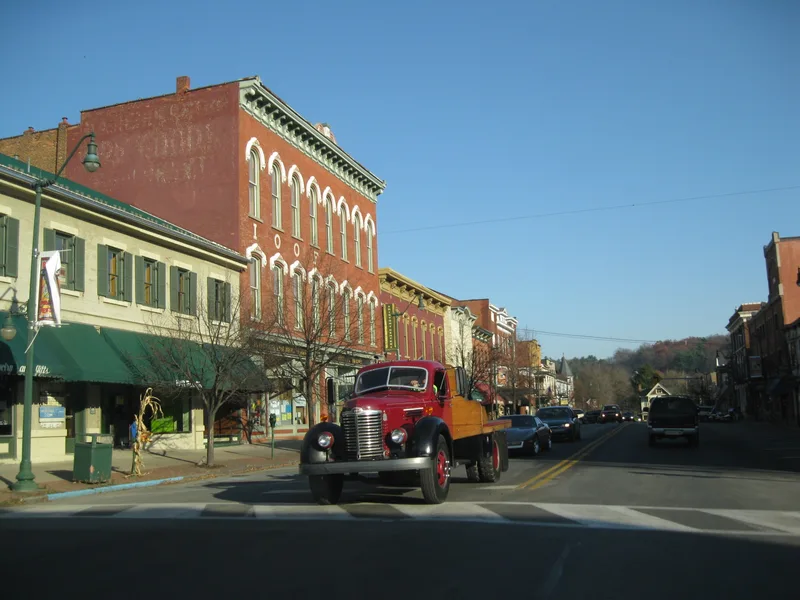
Brookville is a mixed-use district in the Borough of Brookville, Jefferson County, covering about 90 acres on a hillside north of Redbank Creek. Its commercial core along Main Street, which is 90 feet wide, holds Italianate blocks such as the Blood Block of 1875-1876 and the Marlin Opera House Block of 1883-1884. The town became county seat in 1830 and grew as a center of the regional lumber trade, which by the 1860s shipped an estimated 20 million feet annually through more than fifty mills. Surrounding residences range from Greek Revival houses such as the Joseph E. Hall House, ca. 1848, to Queen Anne, Second Empire and Colonial Revival homes. The district is also associated with Civil War service, an Underground Railroad refuge at the Judge Elijah Heath house, and an 1857 dissection that later influenced Pennsylvania law. Two large stone churches and several Gothic Revival churches add to its architectural range.
Significance in brief: The district is significant as the county seat from 1830 and as the center of the region's lumber trade, with commercial and residential buildings representing a range of nineteenth- and early twentieth-century styles. It is also associated with local military service in the Civil War, an Underground Railroad refuge, and an 1857 illegal dissection that led to later state legislation on medical dissection.
Machine-generated summary. This summary was generated by a language model from the official nomination document and has not been reviewed line by line by an editor. It may contain errors. Check the source document before relying on any detail. Source: nomination document (PDF) · National Archives catalog entry. NRHP reference 84003409, listed June 7, 1984. Summary generated October 2026 (model claude-haiku-5-5, prompt v1.1-2026-10-29, confidence medium).
Key facts
| Address | Roughly bounded by RR tracks, Franklin Ave., Church and Main Sts., Brookville |
|---|---|
| County | Jefferson County |
| Listed | June 7, 1984 |
| Reference number | 84003409 |
| Resource type | District |
| Period of significance | 1838-ca. 1930 |
| Architectural style | Greek Revival, Italianate, Gothic Revival, Queen Anne, Second Empire, Colonial Revival |
| Criteria |
|
| Areas of significance | Industry, Commerce, Architecture, Philosophy |
| Level of significance | Local |
| Acreage | 90 |
| Coordinates | 41.16120, -79.08116 (NPS GIS) |
What listing means for this property
This is a historic district. Buildings within its boundary are either contributing (they add to the district's significance) or non-contributing. Owners of contributing income-producing buildings can claim the 20% federal rehabilitation tax credit; homeowners should look at state credits. National Register districts impose no design review by themselves; a local historic district ordinance, if one exists, does (the difference explained).
General information, not legal or tax advice. Rules change; confirm with your State Historic Preservation Office or a qualified adviser.
Sources and further reading
- National Park Service, National Register of Historic Places database (snapshot May 2026), reference 84003409.
- Nomination form (PDF, National Archives) — catalog entry
- Wikipedia article (used for cross-checking only; text not reproduced here)
- Wikidata Q4975208
- This listing as JSON
Last updated October 2026. Found an error? See the editorial policy for how to report it.