Mercersburg Academy
Also known as: Marshall College; Mercersburgh Theological Seminary; Mercersbu

Why it's listed
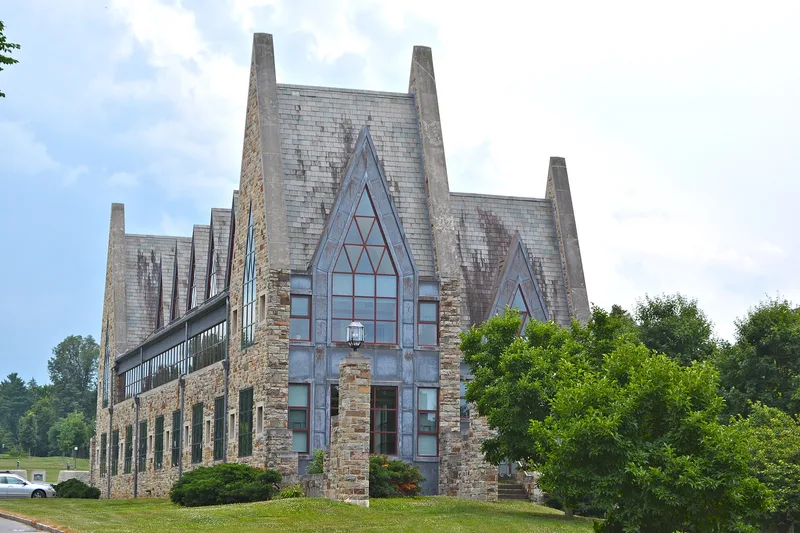
Mercersburg Academy occupies a large open campus on the east edge of Mercersburg, Franklin County, Pennsylvania. The school was founded in 1836 as Marshall College and the Theological Seminary of the German Reformed Church, and its two surviving original buildings, North Cottage and South Cottage, date from the 1830s. The campus took its present form after 1893, when William Mann Irvine reorganized the institution as a preparatory academy and oversaw construction of nine new buildings. Most are Gothic Revival structures in stone and brick, built within roughly thirty years and forming an unusually cohesive group. The Academy Chapel, completed in 1926 with a 43-bell carillon, is regarded as the most outstanding building on campus. The district is significant for its role in American education and for this architectural collection.
Significance in brief: The district is significant for its association with American education in the 19th and 20th centuries, tracing back to the 1836 founding of Marshall College and the Theological Seminary of the German Reformed Church, and for its architecture. Most central buildings are Gothic Revival, built within a roughly 30-year span, which gives the group unusual stylistic cohesion. The Academy Chapel is regarded as the most outstanding building on campus.
Machine-generated summary. This summary was generated by a language model from the official nomination document and has not been reviewed line by line by an editor. It may contain errors. Check the source document before relying on any detail. Source: nomination document (PDF) · National Archives catalog entry. NRHP reference 84003374, listed June 21, 1984. Summary generated October 2026 (model claude-haiku-5-5, prompt v1.1-2026-10-29, confidence high).
Key facts
| Address | PA 16, Mercersburg |
|---|---|
| County | Franklin County |
| Listed | June 21, 1984 |
| Reference number | 84003374 |
| Resource type | District |
| Period of significance | 1836-1972 |
| Architectural style | Gothic Revival; Classical Revival |
| Criteria |
|
| Areas of significance | Education, Architecture |
| Level of significance | Local |
| Status (as stated in the nomination) | The form describes the buildings as in excellent condition and notes the school is an independent secondary school. |
| Acreage | 15 |
| Coordinates | 39.82654, -77.90004 (NPS GIS) |
What listing means for this property
This is a historic district. Buildings within its boundary are either contributing (they add to the district's significance) or non-contributing. Owners of contributing income-producing buildings can claim the 20% federal rehabilitation tax credit; homeowners should look at state credits. National Register districts impose no design review by themselves; a local historic district ordinance, if one exists, does (the difference explained).
General information, not legal or tax advice. Rules change; confirm with your State Historic Preservation Office or a qualified adviser.
Sources and further reading
- National Park Service, National Register of Historic Places database (snapshot May 2026), reference 84003374.
- Nomination form (PDF, National Archives) — catalog entry
- Wikipedia article (used for cross-checking only; text not reproduced here)
- Wikidata Q6818330
- This listing as JSON
Last updated October 2026. Found an error? See the editorial policy for how to report it.