Greencastle Historic District

Why it's listed
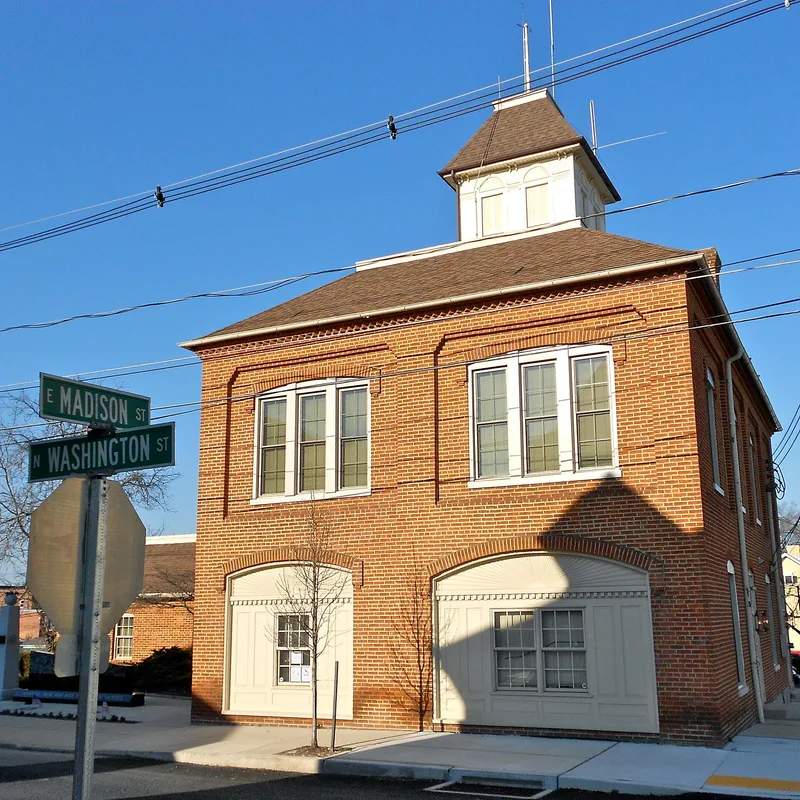
Greencastle is a town of roughly 3,700 people in the Cumberland Valley of southern Franklin County, and its historic district covers about 350 properties around the town square where Carlisle Street meets Baltimore Street. The town was laid out in 1782 by Col. John Allison, who divided 300 acres into 256 lots. Its position at the crossing of two 18th century highways made it a trade and tavern center. Buildings range from late 18th century log and brick structures and brick Federal houses to Italianate banks and hotels and early 20th century Classical Revival commercial blocks, many with brick, cut stone trim and quoins. The First National Bank clock tower dates from 1874. The Cumberland Valley Railroad reached the town in 1840. Tree-lined streets and brick sidewalks with stone curbs remain character-defining features.
Significance in brief: The district is significant for its collection of late 18th through early 20th century buildings representing the town's development, including Federal, Second Empire, Italianate and Classical Revival architecture. The nomination argues that Greencastle's architecture reflects an unusual variety of expression across several periods, because its downtown early buildings were not largely removed or altered during late 19th century growth. Its associations with the Cumberland Valley Railroad and regional commerce are also cited.
Machine-generated summary. This summary was generated by a language model from the official nomination document and has not been reviewed line by line by an editor. It may contain errors. Check the source document before relying on any detail. Source: nomination document (PDF) · National Archives catalog entry. NRHP reference 92001722, listed December 24, 1992. Summary generated October 2026 (model claude-haiku-5-5, prompt v1.1-2026-10-29, confidence high).
Key facts
| Address | Roughly bounded by Washington, PA 2002, Jefferson, Mifflin, Chambers, Grant and Allison, and Baltimore N to Spring Grove, Greencastle |
|---|---|
| County | Franklin County |
| Listed | December 24, 1992 |
| Reference number | 92001722 |
| Resource type | District |
| Period of significance | Ca 1780-1940 |
| Architectural style | Early Republican/Federal; Late Victorian/Second Empire; Late 19th and 20th Century Revivals/Classical Revival |
| Criteria |
|
| Areas of significance | Commerce, Architecture |
| Level of significance | Local |
| Status (as stated in the nomination) | The buildings in the district are generally in excellent condition. |
| Acreage | 100 |
| Coordinates | 39.79067, -77.72446 (NPS GIS) |
What listing means for this property
This is a historic district. Buildings within its boundary are either contributing (they add to the district's significance) or non-contributing. Owners of contributing income-producing buildings can claim the 20% federal rehabilitation tax credit; homeowners should look at state credits. National Register districts impose no design review by themselves; a local historic district ordinance, if one exists, does (the difference explained).
General information, not legal or tax advice. Rules change; confirm with your State Historic Preservation Office or a qualified adviser.
Sources and further reading
- National Park Service, National Register of Historic Places database (snapshot May 2026), reference 92001722.
- Nomination form (PDF, National Archives) — catalog entry
- Wikipedia article (used for cross-checking only; text not reproduced here)
- Wikidata Q5603795
- This listing as JSON
Last updated October 2026. Found an error? See the editorial policy for how to report it.