Rabb, Andrew, House

Why it's listed
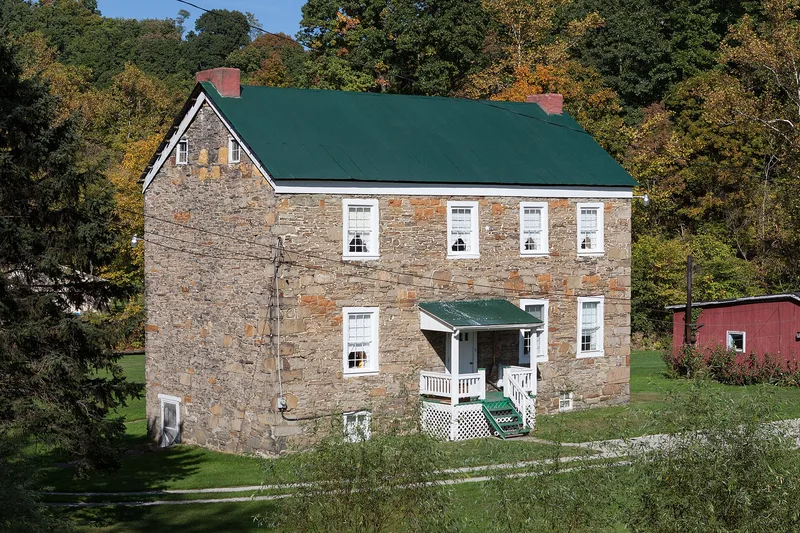
Built in 1773 as a 2½-story, five-bay stone house above Brown's Run in German Township, Fayette County, the Rabb House follows a plain vernacular Georgian plan with a central hall and stair and no exterior ornament. Its stone walls, flat-arched windows with central keystones, and an unusually high cornice remain largely intact, though a fire in the late nineteenth or early twentieth century led to a roof rebuild. Andrew Rabb (c. 1740-1804) was a wealthy distiller, justice of the peace and former captain in the Westmoreland rangers. He was assessed with four stills in 1795 and was one of the wealthiest men in German Township by 1796. He was charged, though never proven guilty, with offering a reward for the death of an excise collector during the Whiskey Rebellion, and later helped represent the township at the 1794 Parkinson's Ferry meeting. The house is significant as one of few pre-1798 stone houses surviving in the region.
Significance in brief: The house is regarded as a rare survivor of a late 18th-century vernacular stone house in southwestern Pennsylvania, and few stone houses from before 1798 are documented as extant in the region. Its builder, Andrew Rabb, was a prominent distiller and local leader who was involved in the Whiskey Rebellion protests against the excise tax.
Machine-generated summary. This summary was generated by a language model from the official nomination document and has not been reviewed line by line by an editor. It may contain errors. Check the source document before relying on any detail. Source: nomination document (PDF) · National Archives catalog entry. NRHP reference 92001497, listed November 12, 1992. Summary generated October 2026 (model claude-haiku-5-5, prompt v1.1-2026-10-29, confidence medium).
Key facts
| Address | Off PA 166 N of Masontown, German Township, Masontown |
|---|---|
| County | Fayette County |
| Listed | November 12, 1992 |
| Reference number | 92001497 |
| Resource type | Building |
| Period of significance | 1773-1804 |
| Architectural style | Vernacular Georgian |
| Criteria |
|
| Areas of significance | Politics/Government, Architecture |
| Level of significance | Local |
| Acreage | 0.8 |
| Coordinates | 39.87089, -79.90721 (NPS GIS) |
What listing means for this property
National Register listing is honorary for a privately owned home: it does not by itself restrict what an owner may do with their own money, and it does not require public access. Restrictions come from local landmark or historic-district ordinances, which are separate (how they differ).
Owner-occupied houses are not eligible for the 20% federal rehabilitation tax credit, which applies to income-producing buildings, but many states offer credits for homeowners. Listing also opens the door to preservation easements and to buying a plaque. Start with what listing means for homeowners, renovating a listed house and selling one.
General information, not legal or tax advice. Rules change; confirm with your State Historic Preservation Office or a qualified adviser.
Sources and further reading
- National Park Service, National Register of Historic Places database (snapshot May 2026), reference 92001497.
- Nomination form (PDF, National Archives) — catalog entry
- Wikipedia article (used for cross-checking only; text not reproduced here)
- Wikidata Q4758347
- This listing as JSON
Last updated October 2026. Found an error? See the editorial policy for how to report it.