Cashier's House
Also known as: See Also:Cashier's House and Coach House (Boundary Increase)

Why it's listed
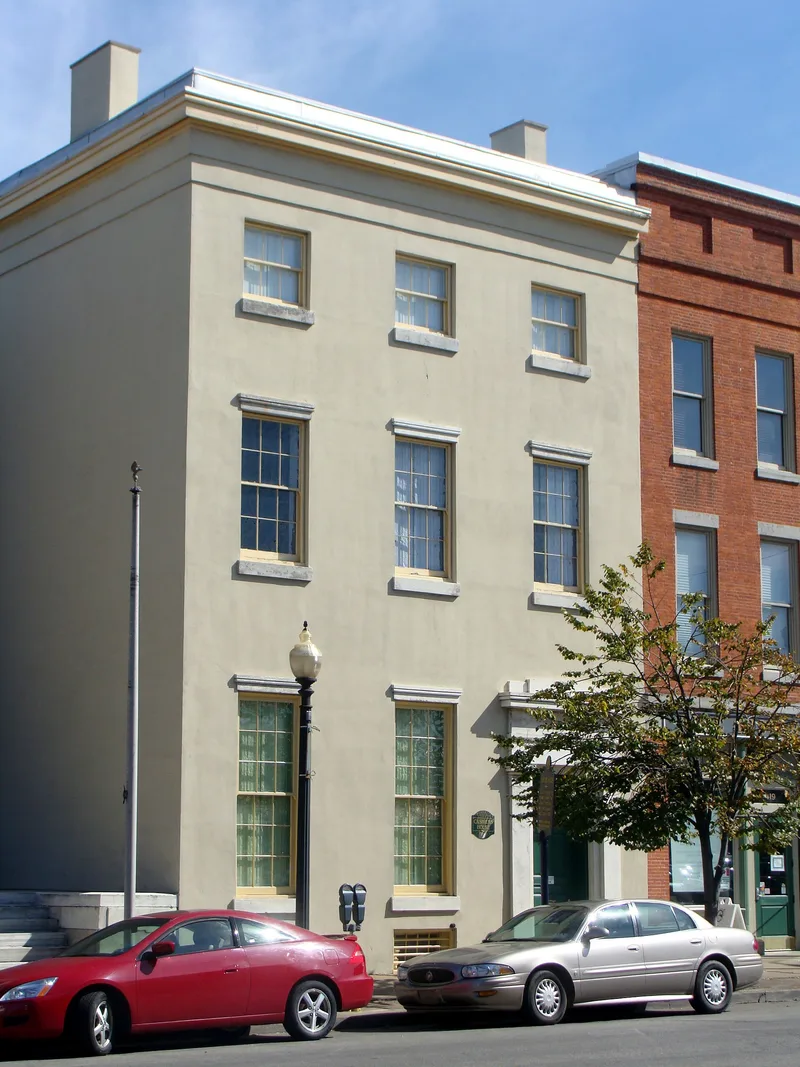
Built circa 1839 beside the Customs House in Erie, this three-story plastered brick building was constructed for Peter Benson, the first cashier of the Erie Branch of the United States Bank of Pennsylvania. Benson moved to Erie from Cincinnati to take up the post. The exterior is plain and austere, with three half windows on the third floor, three full windows on the second, and a pilastered entrance on the first floor. The interior is far more ornate and is regarded as an excellent example of the Egyptian Revival style, with ceilings decorated with egg-and-dart anthemion and Greek fret circular patterns that match those in the Customs House. The building is valued for its architecture and for its link to early banking and commerce in Erie. After the Erie Branch closed upon the expiration of the parent bank's charter, the building was sold in 1849 for four thousand dollars.
Significance in brief: The building is an excellent example of the short-lived Egyptian Revival style of architecture. Its interior is described as an excellent example of that style and matches decoration found in the Customs House. It also reflects the early growth of business and finance in America and the rapid growth of Erie County.
Machine-generated summary. This summary was generated by a language model from the official nomination document and has not been reviewed line by line by an editor. It may contain errors. Check the source document before relying on any detail. Source: nomination document (PDF) · National Archives catalog entry. NRHP reference 72001121, listed January 13, 1972. Summary generated October 2026 (model claude-haiku-5-5, prompt v1.1-2026-10-29, confidence medium).
Key facts
| Address | 413 State St., Erie |
|---|---|
| County | Erie County |
| Listed | January 13, 1972 |
| Reference number | 72001121 |
| Resource type | Building |
| Architectural style | Egyptian Revival |
| Criteria |
|
| Areas of significance | Commerce, Architecture |
| Level of significance | National |
| Status (as stated in the nomination) | Last used as a wholesale drug supply house before being acquired by the Commonwealth of Pennsylvania. |
| Acreage | 0.9 |
| Coordinates | 42.12996, -80.08582 (NPS GIS) |
What listing means for this property
National Register listing is honorary for a privately owned home: it does not by itself restrict what an owner may do with their own money, and it does not require public access. Restrictions come from local landmark or historic-district ordinances, which are separate (how they differ).
Owner-occupied houses are not eligible for the 20% federal rehabilitation tax credit, which applies to income-producing buildings, but many states offer credits for homeowners. Listing also opens the door to preservation easements and to buying a plaque. Start with what listing means for homeowners, renovating a listed house and selling one.
General information, not legal or tax advice. Rules change; confirm with your State Historic Preservation Office or a qualified adviser.
Sources and further reading
- National Park Service, National Register of Historic Places database (snapshot May 2026), reference 72001121.
- Nomination form (PDF, National Archives) — catalog entry
- Wikipedia article (used for cross-checking only; text not reproduced here)
- Wikidata Q5048740
- This listing as JSON
Last updated October 2026. Found an error? See the editorial policy for how to report it.