Grange, The
Also known as: Maen-Coch,Clifton Hall

Why it's listed
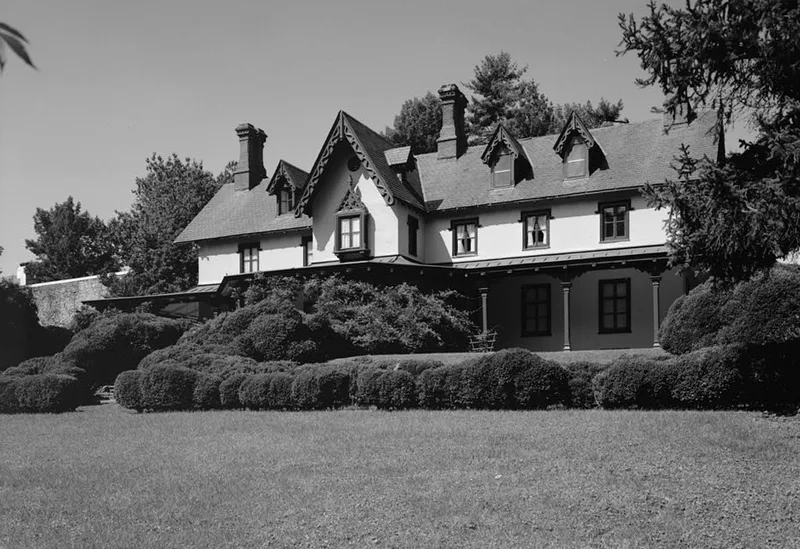
Set on a 10-acre tract in Haverford, Pennsylvania, the Grange began as a modest dwelling built after Henry Lewis, a Welsh Quaker, acquired the land from William Penn in 1683. Captain John Willcox erected a larger Georgian house in 1750, and Captain Charles Cruikshank added a substantial southeast section around 1760 along with terraced walks, greenhouses and a bath house. In 1850 Dr. John Ashurst remodeled the house in Victorian Gothic Revival style, covering the stone with stucco and adding a wraparound veranda and a gable with decorative barge-boards. The property is significant for its gardens, which were laid out in the 1760s and contain formal terraces, specimen trees and a forested walk, and for its gatherings under John Ross, a wealthy merchant and banker, during 1782 to 1800. Visitors then reportedly included George Washington, Benjamin Franklin and Lafayette. Its architecture is also regarded as a good example of pre-Civil War Gothic Revival design in America.
Significance in brief: The nomination argues the property is significant for its associations with prominent statesmen and social figures who gathered there, for its Victorian Gothic Revival remodeling of the pre-Civil War period, and for its old and extensive gardens and woodland. It states that the gardens have been tended for over 200 years and record a unique history of landscape taste.
Machine-generated summary. This summary was generated by a language model from the official nomination document and has not been reviewed line by line by an editor. It may contain errors. Check the source document before relying on any detail. Source: nomination document (PDF) · National Archives catalog entry. NRHP reference 76001636, listed January 11, 1976. Summary generated October 2026 (model claude-haiku-5-5, prompt v1.1-2026-10-29, confidence medium).
Key facts
| Address | Grove Pl., Haverford |
|---|---|
| County | Delaware County |
| Listed | January 11, 1976 |
| Reference number | 76001636 |
| Resource type | Building |
| Period of significance | c.1685, 1760, 1850 |
| Architectural style | Georgian; Victorian Gothic Revival |
| Areas of significance | Landscape Architecture, Architecture |
| Level of significance | National |
| Status (as stated in the nomination) | The nomination states the Grange has remained much as it was in the Civil War years and that its gardens were restored in 1913 after a brief period of neglect. |
| Acreage | 9.9 |
| Coordinates | 39.97591, -75.28432 (NPS GIS) |
What listing means for this property
National Register listing is honorary: it recognises significance and does not restrict what a private owner may do without federal money or permits. It unlocks the 20% federal rehabilitation tax credit for income-producing buildings, state credits in many states, and Section 106 review when federal agencies are involved. See what listing means in practice.
General information, not legal or tax advice. Rules change; confirm with your State Historic Preservation Office or a qualified adviser.
Sources and further reading
- National Park Service, National Register of Historic Places database (snapshot May 2026), reference 76001636.
- Nomination form (PDF, National Archives) — catalog entry
- Wikipedia article (used for cross-checking only; text not reproduced here)
- Wikidata Q5595644
- This listing as JSON
Last updated October 2026. Found an error? See the editorial policy for how to report it.