Chadds Ford Historic District
Also known as: See Also:Chad House; Wyeth, N.C., House and Studio NHL
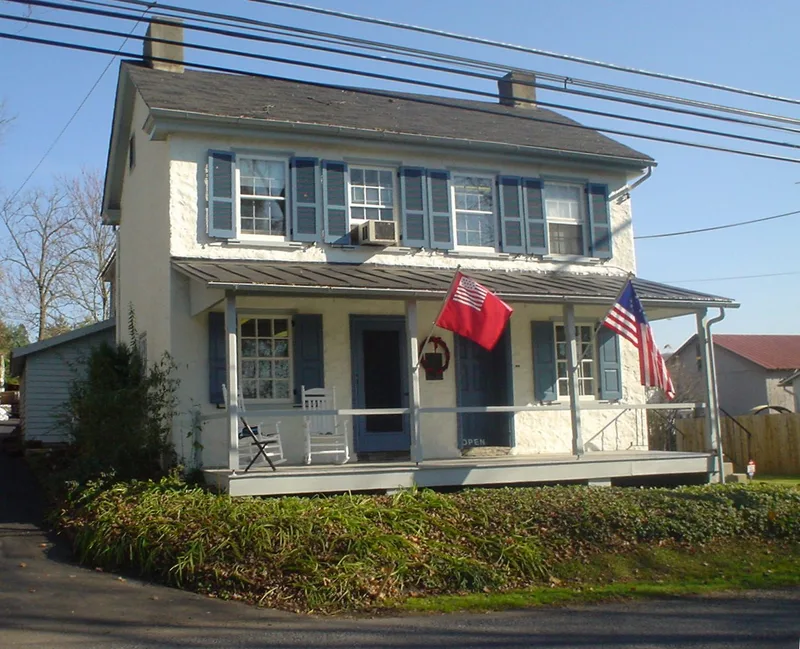

Why it's listed
Chadds Ford is a village at the crossroads of U.S. Route 1 and Pennsylvania Route 100 in Delaware County, Pennsylvania. Its origins go back to 1703, when Francis Chadsey, to whom William Penn granted the land, built a grist mill on the Brandywine Creek. His son John built a stone house and springhouse before 1726, and in 1731 he was licensed to keep a tavern in the brick house. Five years later he received a license to operate a ferry across the Brandywine on the road to Nottingham. The village's buildings date mainly from the early 1800s and later, including the Chads Ford Inn, built between 1807 and 1810, and the Merchant Mill, built by George Brinton in 1864. Most of the village's buildings are modest. The district is significant because it preserves the character of a small rural hamlet and because its land was part of the American encampment during the Battle of the Brandywine in September 1777.
Significance in brief: The nomination argues the village is typical of the region's small hamlets and has not been altered by non-conforming uses, so it preserves its historic character. It cites the 1777 Battle of the Brandywine, which encamped the American army around the village, and the early grist mill and ferry that shaped the village's commercial life. It notes the middle-class architecture and the village's simplicity as its architectural significance.
Machine-generated summary. This summary was generated by a language model from the official nomination document and has not been reviewed line by line by an editor. It may contain errors. Check the source document before relying on any detail. Source: nomination document (PDF) · National Archives catalog entry. NRHP reference 71000699, listed November 23, 1971. Summary generated October 2026 (model claude-haiku-5-5, prompt v1.1-2026-10-29, confidence medium).
Key facts
| Address | Jct. of U.S. 1 and PA 100, Chadds Ford |
|---|---|
| County | Delaware County |
| Listed | November 23, 1971 |
| Reference number | 71000699 |
| Resource type | District |
| Period of significance | 18th Century to 19th Century |
| Areas of significance | Architecture, Historic - Non-Aboriginal |
| Level of significance | National |
| Status (as stated in the nomination) | The village remains in use as a village; the John Chad stone house is being restored for use as the historical society headquarters. |
| Acreage | 86 |
| Within district | Brandywine Battlefield |
| Coordinates | 39.87158, -75.59149 (NPS GIS) |
What listing means for this property
This is a historic district. Buildings within its boundary are either contributing (they add to the district's significance) or non-contributing. Owners of contributing income-producing buildings can claim the 20% federal rehabilitation tax credit; homeowners should look at state credits. National Register districts impose no design review by themselves; a local historic district ordinance, if one exists, does (the difference explained).
General information, not legal or tax advice. Rules change; confirm with your State Historic Preservation Office or a qualified adviser.
Sources and further reading
- National Park Service, National Register of Historic Places database (snapshot May 2026), reference 71000699.
- Nomination form (PDF, National Archives) — catalog entry
- Wikipedia article (used for cross-checking only; text not reproduced here)
- Wikidata Q5066426
- This listing as JSON
Last updated October 2026. Found an error? See the editorial policy for how to report it.