Brandywine Summit Camp Meeting

Why it's listed
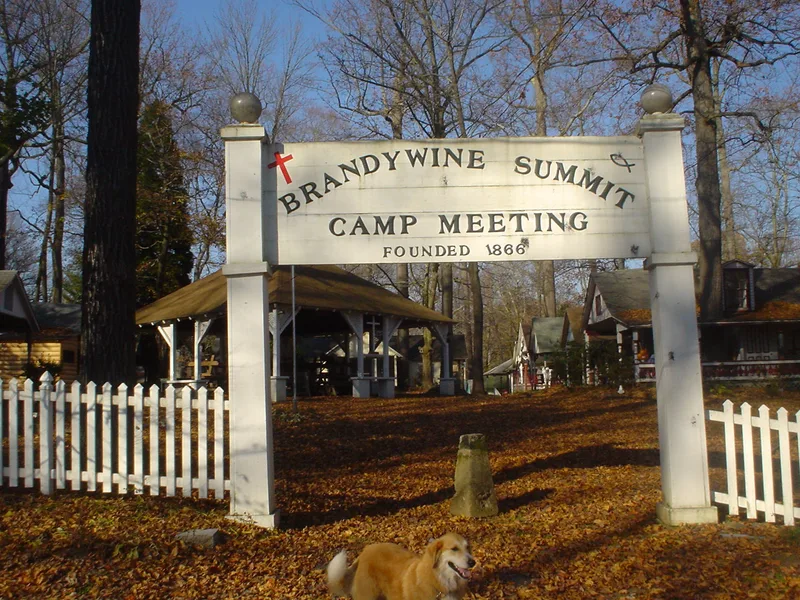
Brandywine Summit Camp Meeting is a Methodist camp meeting in Concord Township, Delaware County, Pennsylvania, occupying about thirteen acres of wooded hillside. Its community grew from canvas tents pitched in July 1867 in an area known as Johnson's Woods, and by the early twentieth century the tents had been replaced by one-story gabled cottages, many still standing on their original tent platforms. The camp is organized around a central Circle with an 1884 tabernacle, with cottages lining avenues named for member churches. Religious services ran nearly all day during the camp season, and traditions such as the closing sacred concert and the Money Tree ceremony continue. The site is regarded as one of the best-preserved surviving camp meetings in Pennsylvania, and its layout and vernacular architecture illustrate the type of camp meeting that spread across the country after the Civil War.
Significance in brief: The nomination argues that the camp is one of Pennsylvania's oldest continuously operating Methodist camp meetings and a well-preserved example of the post-Civil War camp meeting movement. Its cottages evolved from canvas tents and its plan and tabernacle reflect典型 camp meeting design, giving it significance under religion and architecture.
Machine-generated summary. This summary was generated by a language model from the official nomination document and has not been reviewed line by line by an editor. It may contain errors. Check the source document before relying on any detail. Source: nomination document (PDF) · National Archives catalog entry. NRHP reference 95000132, listed February 24, 1995. Summary generated October 2026 (model claude-haiku-5-5, prompt v1.1-2026-10-29, confidence high).
Key facts
| Address | 119 Beaver Valley Rd., Concord Township, Chadds Ford |
|---|---|
| County | Delaware County |
| Listed | February 24, 1995 |
| Reference number | 95000132 |
| Resource type | District |
| Period of significance | C. 1884-1943 |
| Architectural style | Late Victorian; vernacular cottages |
| Criteria |
|
| Areas of significance | Religion, Architecture |
| Level of significance | State |
| Status (as stated in the nomination) | The camp remains in use for religious gatherings; the cottages are generally occupied by cottage owners. |
| Acreage | 13 |
| Coordinates | 39.85218, -75.54768 (NPS GIS) |
What listing means for this property
This is a historic district. Buildings within its boundary are either contributing (they add to the district's significance) or non-contributing. Owners of contributing income-producing buildings can claim the 20% federal rehabilitation tax credit; homeowners should look at state credits. National Register districts impose no design review by themselves; a local historic district ordinance, if one exists, does (the difference explained).
General information, not legal or tax advice. Rules change; confirm with your State Historic Preservation Office or a qualified adviser.
Sources and further reading
- National Park Service, National Register of Historic Places database (snapshot May 2026), reference 95000132.
- Nomination form (PDF, National Archives) — catalog entry
- Wikipedia article (used for cross-checking only; text not reproduced here)
- Wikidata Q4957294
- This listing as JSON
Last updated October 2026. Found an error? See the editorial policy for how to report it.