Strickland-Roberts Homestead
Also known as: Bryncoed Farm

Why it's listed
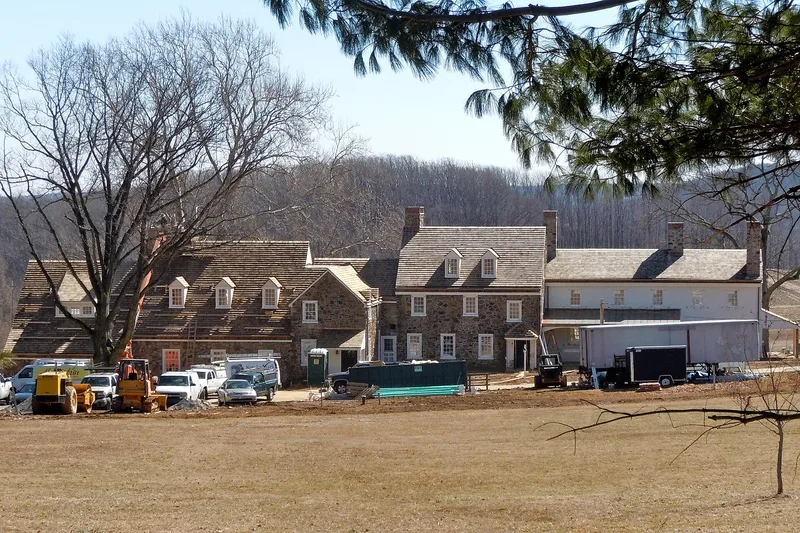
Set on a gentle bank in Kimberton, Chester County, this farmstead centres on a stone farmhouse built in two sections in the early 1800s, probably by William Strickland, who was taxed for a log house on the site in 1798. The stone core is three bays wide and was extended to five bays soon after construction. In 1873 William Friday built the stone bank barn, which has a frame forebay on conical stone piers facing a walled courtyard. Owen J. Roberts, a Philadelphia lawyer and University of Pennsylvania law professor, bought the property in 1927 and added a large random fieldstone wing in 1929 to plans by R. Broghard Oakie without disturbing the original dwelling. Roberts was later one of the prosecutors in the Teapot Dome oil scandal cases, chaired a commission on the Pearl Harbor attack, and sat on the Supreme Court from 1930. The property is valued for its association with him and for the way the house grew through successive owners.
Significance in brief: The nomination argues the property is significant for its long association with Owen J. Roberts, an attorney and law professor who later served as a U.S. Supreme Court Justice, and for its architecture as an early stone house adapted and added to over successive generations. The house is described as having remained substantially intact since the early 1800s.
Machine-generated summary. This summary was generated by a language model from the official nomination document and has not been reviewed line by line by an editor. It may contain errors. Check the source document before relying on any detail. Source: nomination document (PDF) · National Archives catalog entry. NRHP reference 78002372, listed January 30, 1978. Summary generated October 2026 (model claude-haiku-5-5, prompt v1.1-2026-10-29, confidence medium).
Key facts
| Address | 3 mi. (4.8 km) S of Kimberton on St. Matthews Rd., West Vincent Township, Kimberton |
|---|---|
| County | Chester County |
| Listed | January 30, 1978 |
| Reference number | 78002372 |
| Resource type | Building |
| Period of significance | c. 1800 |
| Architect / builder | R. Broghard Oakie (architect, 1929 addition); William Friday (barn, 1873) |
| Areas of significance | Law, Architecture |
| Level of significance | State |
| Acreage | 3.5 |
| Coordinates | 40.12227, -75.63466 (NPS GIS) |
What listing means for this property
National Register listing is honorary for a privately owned home: it does not by itself restrict what an owner may do with their own money, and it does not require public access. Restrictions come from local landmark or historic-district ordinances, which are separate (how they differ).
Owner-occupied houses are not eligible for the 20% federal rehabilitation tax credit, which applies to income-producing buildings, but many states offer credits for homeowners. Listing also opens the door to preservation easements and to buying a plaque. Start with what listing means for homeowners, renovating a listed house and selling one.
General information, not legal or tax advice. Rules change; confirm with your State Historic Preservation Office or a qualified adviser.
Sources and further reading
- National Park Service, National Register of Historic Places database (snapshot May 2026), reference 78002372.
- Nomination form (PDF, National Archives) — catalog entry
- Wikipedia article (used for cross-checking only; text not reproduced here)
- Wikidata Q7623587
- This listing as JSON
Last updated October 2026. Found an error? See the editorial policy for how to report it.