Glen Rose Historic District

Why it's listed
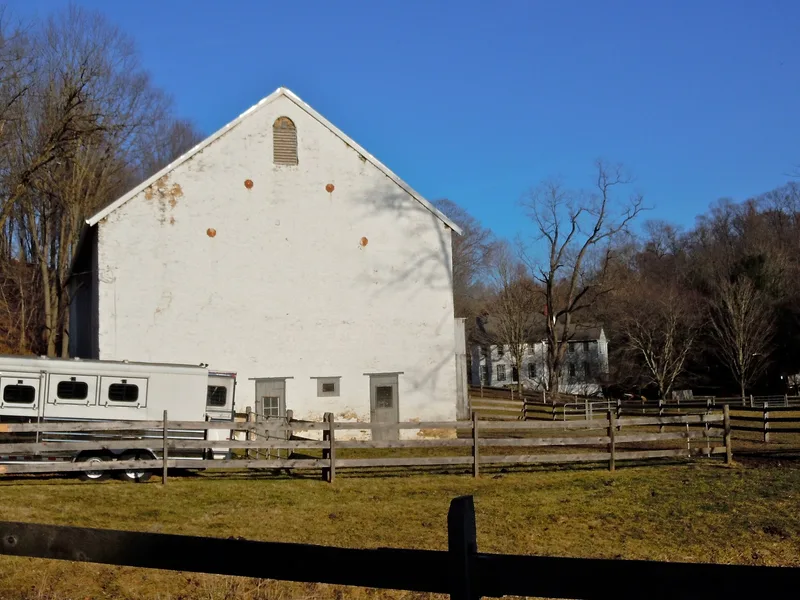
Glen Rose is a small hamlet on a slope above Buck Run in East Fallowfield Township, Chester County, Pennsylvania. Its core buildings were mostly erected before 1850. Thomas Truman's grist mill dates to about 1775, and George Passmore's log cobbler shop to about 1805. Passmore's cider mill followed around 1825. Water from Buck Run powered milling here, and farm produce from surrounding townships was processed at the mill. James Newlin bought the complex in 1835 and built a Federal-style house around 1836. Joseph Brinton later owned and operated the commercial district. Commercial activity declined after the turn of the twentieth century, and most of the earlier buildings have since been converted to residential use. The district is regarded as a well-preserved, cohesive example of a late eighteenth and early nineteenth century rural village built around milling and trade.
Significance in brief: The district is argued to be locally significant as a late eighteenth and early nineteenth century agrarian commercial crossroads, where water power from Buck Run supported milling and related trades. Its vernacular farmhouses and minor commercial buildings are regarded as a cohesive, well-preserved example of the township's second period of development, 1761-1810.
Machine-generated summary. This summary was generated by a language model from the official nomination document and has not been reviewed line by line by an editor. It may contain errors. Check the source document before relying on any detail. Source: nomination document (PDF) · National Archives catalog entry. NRHP reference 85002384, listed September 18, 1985. Summary generated October 2026 (model claude-haiku-5-5, prompt v1.1-2026-10-29, confidence high).
Key facts
| Address | SRs 15178 and T371, Coatesville |
|---|---|
| County | Chester County |
| Listed | September 18, 1985 |
| Reference number | 85002384 |
| Resource type | District |
| Period of significance | 1761-1810 |
| Architectural style | Vernacular; George Passmore House described as a conservative interpretation of the Federal style |
| Areas of significance | Commerce |
| Level of significance | Local |
| Status (as stated in the nomination) | Several buildings have been adapted as residences; many earlier structures have been demolished. |
| Acreage | 9 |
| Coordinates | 39.94396, -75.85845 (NPS GIS) |
What listing means for this property
This is a historic district. Buildings within its boundary are either contributing (they add to the district's significance) or non-contributing. Owners of contributing income-producing buildings can claim the 20% federal rehabilitation tax credit; homeowners should look at state credits. National Register districts impose no design review by themselves; a local historic district ordinance, if one exists, does (the difference explained).
General information, not legal or tax advice. Rules change; confirm with your State Historic Preservation Office or a qualified adviser.
Sources and further reading
- National Park Service, National Register of Historic Places database (snapshot May 2026), reference 85002384.
- Nomination form (PDF, National Archives) — catalog entry
- Wikipedia article (used for cross-checking only; text not reproduced here)
- Wikidata Q5568015
- This listing as JSON
Last updated October 2026. Found an error? See the editorial policy for how to report it.