Como Farm
Also known as: Site #50-1

Why it's listed
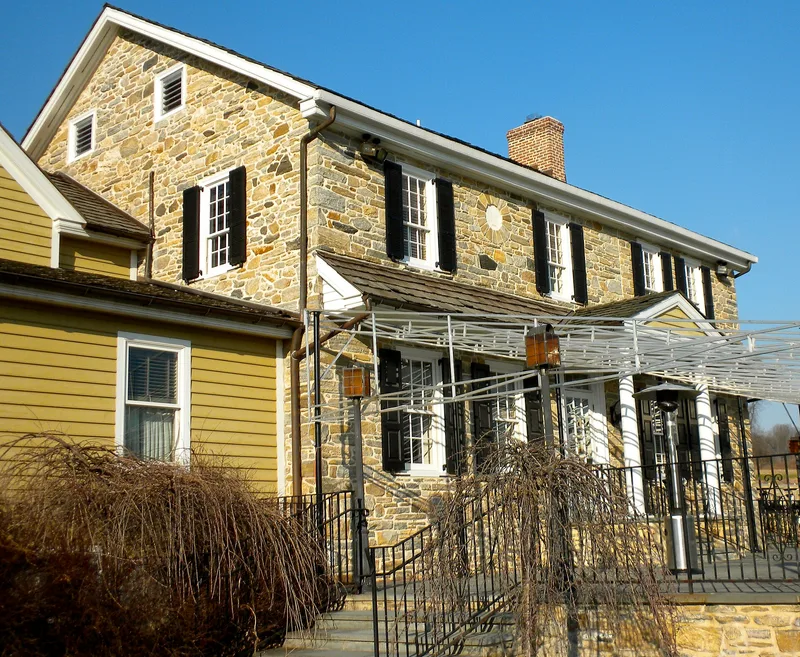
Como Farm is a stone farmhouse on Broad Run Road in West Bradford Township, Chester County, Pennsylvania, on a hill above the Broad Run valley. Its core is three bays wide and double pile, with a full basement and a datestone of 1702. The house was enlarged in 1802, when a central hall was added, and the enlargement brought a graceful open string stairway, a gable roof, and six-over-two paneled doors. The basement preserves the original two-room hall/parlor plan, which closely resembles that of the 1755 Carpenter Farm downstream. A frame banked barn also contributes to the property. John Beale Bordley bought the land in 1792 and named it after the Italian birthplace of Pliny. Bordley was a leading agriculturist whose experiments in crop rotation and soil fertility were influential. His purchase is regarded as the earliest recorded attempt at scientific agriculture in the corridor.
Significance in brief: The house is significant for its early 18th-century hall/parlor plan, which the nomination compares to the 1755 Carpenter Farm nearby, and for its association with agriculturist John Beale Bordley, who bought the property in 1792 and is credited with early scientific farming in the West Branch Brandywine corridor. The barn is also counted as a contributing resource.
Machine-generated summary. This summary was generated by a language model from the official nomination document and has not been reviewed line by line by an editor. It may contain errors. Check the source document before relying on any detail. Source: nomination document (PDF) · National Archives catalog entry. NRHP reference 85002348, listed September 16, 1985. Summary generated October 2026 (model claude-haiku-5-5, prompt v1.1-2026-10-29, confidence medium).
Key facts
| Address | Broad Run Rd., W. Bradford Twp. |
|---|---|
| County | Chester County |
| Listed | September 16, 1985 |
| Reference number | 85002348 |
| Resource type | Building |
| Period of significance | 1700-1799; 1800-1899 |
| Architectural style | Late Georgian Quaker-built stone farmhouse |
| Areas of significance | Agriculture |
| Level of significance | Local |
| Status (as stated in the nomination) | The property is owned by a non-profit charitable organization and is not open for prolonged public visitation. |
| Acreage | 8 |
| Coordinates | 39.95230, -75.70686 (NPS GIS) |
What listing means for this property
National Register listing is honorary for a privately owned home: it does not by itself restrict what an owner may do with their own money, and it does not require public access. Restrictions come from local landmark or historic-district ordinances, which are separate (how they differ).
Owner-occupied houses are not eligible for the 20% federal rehabilitation tax credit, which applies to income-producing buildings, but many states offer credits for homeowners. Listing also opens the door to preservation easements and to buying a plaque. Start with what listing means for homeowners, renovating a listed house and selling one.
General information, not legal or tax advice. Rules change; confirm with your State Historic Preservation Office or a qualified adviser.
Sources and further reading
- National Park Service, National Register of Historic Places database (snapshot May 2026), reference 85002348.
- Nomination form (PDF, National Archives) — catalog entry
- Wikipedia article (used for cross-checking only; text not reproduced here)
- Wikidata Q120108055
- This listing as JSON
Last updated October 2026. Found an error? See the editorial policy for how to report it.