Boalsburg Historic District

Why it's listed
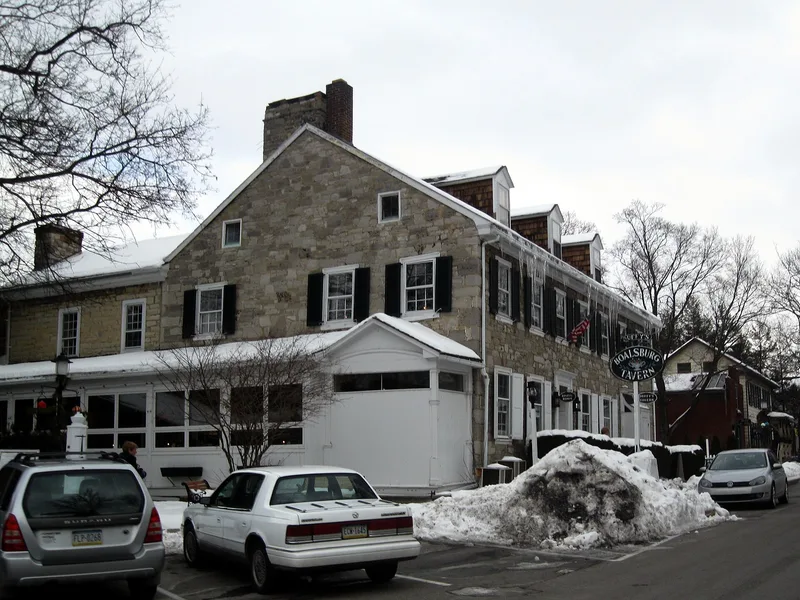
Boalsburg developed around an intersection of principal roads, and the town was laid out by Andrew Stroup in 1808. Its commercial core runs along Main Street, with residential streets on Pine and South Academy, a church area at the north end of Church Street, and a tannery at the east end of Main Street. Early tanning began there when William Murray bought the property in 1811, and a series of twelve tanning vats was uncovered in 1960. The district contains Georgian and Victorian houses, including the Smith-Coverly House, which was owned almost continuously by local doctors from 1835 until 1933. Two substantial churches stand in the north area: St. John's German Reformed Church, built in 1861-1862, and Zion Evangelical Lutheran Church, built in 1867-1868, with its brick colonial form. The Boalsburg Academy and the Presbyterian Church that replaced it in 1892 reflect the town's schooling and worship.
Significance in brief: The nomination argues that the district illustrates the town's early building history through a cohesive group of Georgian, Victorian and Greek Revival era buildings. It also cites its importance for the church and cemetery area, for the early tannery and the Boalsburg Academy, and for its position at the intersection of principal roads that shaped commerce and transportation in the town.
Machine-generated summary. This summary was generated by a language model from the official nomination document and has not been reviewed line by line by an editor. It may contain errors. Check the source document before relying on any detail. Source: nomination document (PDF) · National Archives catalog entry. NRHP reference 77001139, listed December 12, 1977. Summary generated October 2026 (model claude-haiku-5-5, prompt v1.1-2026-10-29, confidence medium).
Key facts
| Address | U.S. 322, Boalsburg |
|---|---|
| County | Centre County |
| Listed | December 12, 1977 |
| Reference number | 77001139 |
| Resource type | District |
| Architectural style | Georgian; Victorian; Greek Revival; Gothic Revival; Norman Revival |
| Areas of significance | Community Planning and Development, Commerce, Transportation, Architecture |
| Level of significance | Local |
| Acreage | 50 |
| Coordinates | 40.77623, -77.79362 (NPS GIS) |
What listing means for this property
This is a historic district. Buildings within its boundary are either contributing (they add to the district's significance) or non-contributing. Owners of contributing income-producing buildings can claim the 20% federal rehabilitation tax credit; homeowners should look at state credits. National Register districts impose no design review by themselves; a local historic district ordinance, if one exists, does (the difference explained).
General information, not legal or tax advice. Rules change; confirm with your State Historic Preservation Office or a qualified adviser.
Sources and further reading
- National Park Service, National Register of Historic Places database (snapshot May 2026), reference 77001139.
- Nomination form (PDF, National Archives) — catalog entry
- Wikipedia article (used for cross-checking only; text not reproduced here)
- Wikidata Q4931247
- This listing as JSON
Last updated October 2026. Found an error? See the editorial policy for how to report it.