Noon, Philip, House
Also known as: YMCA Building of Ebensburg; Phillip Collins House; Noon-Collin

Why it's listed
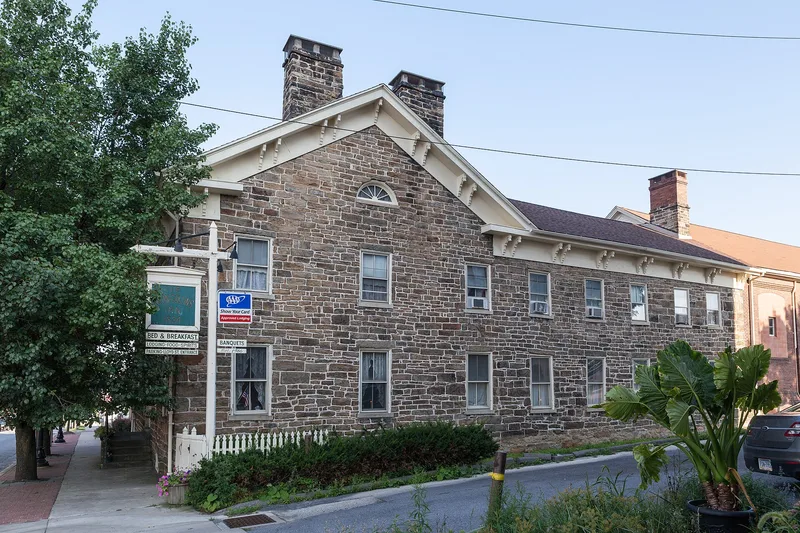
Built in 1834 at the centre of Ebensburg next to the courthouse, this stone house with a gymnasium annex is one of the few surviving Federal style buildings in Cambria County. Its five-bay symmetrical front, central entrance with fan-light windows, massive chimneys and dressed stone corners reflect Late Georgian and Adamesque design adapted to local materials and craftsmanship. The house was built for Philip Noon, who served as county sheriff, treasurer, prothonotary and associate judge. Later it was the home of his son-in-law Philip Collins, a railroad builder whose firm constructed tunnels and lines across Pennsylvania and attempted a railroad in Brazil. Acquired in 1905, it became a YMCA with a gymnasium completed in 1907. The building served the town's youth and civic groups for seventy years and was later used as a library and historical society museum. It has been unoccupied since 1977.
Significance in brief: The nomination argues the house is one of the few remaining Federal style structures in Cambria County and reflects Late Georgian and Adamesque design. It is also tied to Judge Philip Noon, an early county official, and to Philip Collins, a railroad builder whose firm worked on major projects including an unsuccessful Brazilian railroad venture. The building later served the community as a youth center, library and historical society site.
Machine-generated summary. This summary was generated by a language model from the official nomination document and has not been reviewed line by line by an editor. It may contain errors. Check the source document before relying on any detail. Source: nomination document (PDF) · National Archives catalog entry. NRHP reference 84003179, listed August 23, 1984. Summary generated October 2026 (model claude-haiku-5-5, prompt v1.1-2026-10-29, confidence medium).
Key facts
| Address | 114 E. High St., Ebensburg |
|---|---|
| County | Cambria County |
| Listed | August 23, 1984 |
| Reference number | 84003179 |
| Resource type | Building |
| Period of significance | 1834-1907 |
| Architect / builder | Philip Noon, Esq. (builder) |
| Architectural style | Federal; Late Georgian and Adamesque influences |
| Criteria |
|
| Areas of significance | Engineering, Transportation, Architecture, Social History |
| Level of significance | Local |
| Status (as stated in the nomination) | Unoccupied since 1977 according to the document, with the borough offering the property for sale subject to restoration covenants (March 1984). |
| Acreage | 1 |
| Within district | Ebensburg Historic District |
| Coordinates | 40.48475, -78.72435 (NPS GIS) |
What listing means for this property
National Register listing is honorary for a privately owned home: it does not by itself restrict what an owner may do with their own money, and it does not require public access. Restrictions come from local landmark or historic-district ordinances, which are separate (how they differ).
Owner-occupied houses are not eligible for the 20% federal rehabilitation tax credit, which applies to income-producing buildings, but many states offer credits for homeowners. Listing also opens the door to preservation easements and to buying a plaque. Start with what listing means for homeowners, renovating a listed house and selling one.
Noted as vacant in the nomination. Nomination documents can be decades old; current status may differ. If you are considering buying an empty listed property, read the due-diligence checklist.
General information, not legal or tax advice. Rules change; confirm with your State Historic Preservation Office or a qualified adviser.
Sources and further reading
- National Park Service, National Register of Historic Places database (snapshot May 2026), reference 84003179.
- Nomination form (PDF, National Archives) — catalog entry
- Wikipedia article (used for cross-checking only; text not reproduced here)
- Wikidata Q7184148
- This listing as JSON
Last updated October 2026. Found an error? See the editorial policy for how to report it.