Cambria City Historic District

Why it's listed
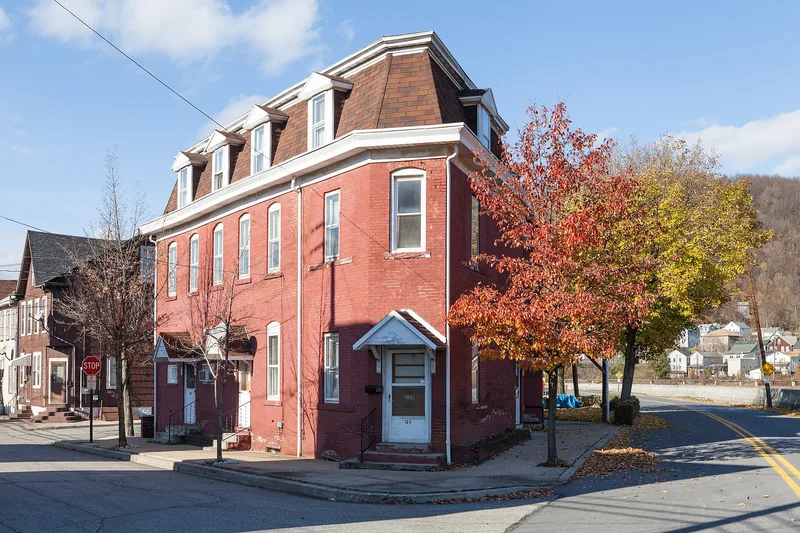
Cambria City is a dense urban neighborhood of two-story vernacular houses built on a grid three blocks wide and ten blocks long in Johnstown, Pennsylvania. Cambria Iron Company's David and James P. McConaughy laid out its lots in 1853 for workers at the nearby ironworks, and the street grid was rebuilt after the 1889 flood. Most of the houses were built between 1890 and 1920 for mill and mine employees, and they are typically two-bay singles or four-bay doubles set close together. The district contains ten churches, most built between 1901 and 1922, which reflect the successive waves of immigrants from south and east central Europe. Five of them were designed by architects including Walter Myton and John T. Comes, and they display Gothic, Romanesque, Renaissance and Byzantine styles. The neighborhood is also associated with the Germania Brewery of 1907, the 1914 Minersville Bridge, and the Mayer slaughterhouse of 1908. It is regarded as the best preserved example of a working-class ethnic neighborhood tied to the Cambria Iron Company in the Johnstown area.
Significance in brief: The nomination argues that the district is significant for its ethnic and cultural history, its architecture and its industrial associations, covering the period 1854 to 1941. It was laid out to house laborers for the Cambria Iron Company, and later immigrant groups from south and east central Europe built churches, schools and associations there. Its vernacular housing and intact urban grid are presented as the best preserved of their kind in the Johnstown area.
Machine-generated summary. This summary was generated by a language model from the official nomination document and has not been reviewed line by line by an editor. It may contain errors. Check the source document before relying on any detail. Source: nomination document (PDF) · National Archives catalog entry. NRHP reference 91001706, listed November 14, 1991. Summary generated October 2026 (model claude-haiku-5-5, prompt v1.1-2026-10-29, confidence high).
Key facts
| Address | Roughly bounded by Broad St., Tenth Ave. and the Conemaugh R., Johnstown |
|---|---|
| County | Cambria County |
| Listed | November 14, 1991 |
| Reference number | 91001706 |
| Resource type | District |
| Period of significance | 1854-1941 |
| Architectural style | Vernacular urban house form; Second Empire; Queen Anne; Victorian Gothic Revival; Romanesque Revival; Second Renaissance Revival; Byzantine Revival; Arts and Crafts |
| Criteria |
|
| Areas of significance | Architecture, European, Industry |
| Level of significance | Local |
| Status (as stated in the nomination) | The district contains 263 buildings and one structure, of which 66 are noncontributing. Many houses have synthetic siding and lost original details after floods, and in the 1960s the city redevelopment authority demolished most of the area west of Broad Street except the former Germania Brewery. |
| Acreage | 39 |
| Coordinates | 40.34151, -78.93024 (NPS GIS) |
What listing means for this property
This is a historic district. Buildings within its boundary are either contributing (they add to the district's significance) or non-contributing. Owners of contributing income-producing buildings can claim the 20% federal rehabilitation tax credit; homeowners should look at state credits. National Register districts impose no design review by themselves; a local historic district ordinance, if one exists, does (the difference explained).
General information, not legal or tax advice. Rules change; confirm with your State Historic Preservation Office or a qualified adviser.
Sources and further reading
- National Park Service, National Register of Historic Places database (snapshot May 2026), reference 91001706.
- Nomination form (PDF, National Archives) — catalog entry
- Wikipedia article (used for cross-checking only; text not reproduced here)
- Wikidata Q5025251
- This listing as JSON
Last updated October 2026. Found an error? See the editorial policy for how to report it.