Downtown Johnstown Historic District
Also known as: Johnstown Central Business District; See Also:75002178; 720011

Why it's listed
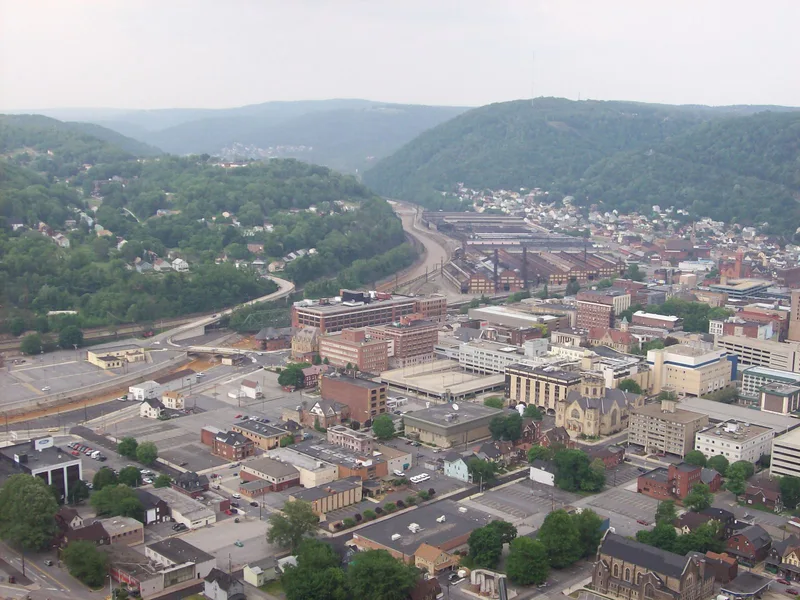
Johnstown's downtown commercial core sits in a river valley at the confluence of Stony Creek and the Little Conemaugh River, laid out on a grid of streets and alleys by founder Joseph Johns in 1800. Most of the roughly 200 buildings were erected between 1890 and 1930, after the 1889 flood, in brick and stone with terra cotta ornament, and they range from two-story storefronts to the six-story Swank Building of 1907. The district contains six churches, a city hall of 1900, a 1912 post office and a 1892 Carnegie library that now houses the Johnstown Flood Museum. Its significance rests on two strands. It served as the trading and government center for Johnstown as Cambria Iron grew into one of the largest iron and steel producers in the country. It also holds the city's most important flood-surviving buildings, including the Franklin Street Methodist Church, whose stone walls are credited with splitting the flood wave, and the Ludwig House, which served as Red Cross headquarters after the disaster.
Significance in brief: The nomination argues the district is significant for commerce and architecture from 1869 to 1940, as a cross-section of mid-to-late nineteenth and early twentieth century styles across commercial, public, religious and residential building types. It is also described as nationally significant for its concentration of resources tied to the 1889 Johnstown flood, including buildings that survived the water and later memorial sites.
Machine-generated summary. This summary was generated by a language model from the official nomination document and has not been reviewed line by line by an editor. It may contain errors. Check the source document before relying on any detail. Source: nomination document (PDF) · National Archives catalog entry. NRHP reference 92000941, listed August 7, 1992. Summary generated October 2026 (model claude-haiku-5-5, prompt v1.1-2026-10-29, confidence high).
Key facts
| Address | Bounded by Washington, Clinton, Bedford, Vine, Market, Locust and Walnut Sts., Johnstown |
|---|---|
| County | Cambria County |
| Listed | August 7, 1992 |
| Reference number | 92000941 |
| Resource type | District |
| Period of significance | 1869-1940 |
| Architectural style | Second Empire, Queen Anne, Romanesque, Classical Revival, Gothic Revival, Art Deco, Art Moderne, Early Modern, Beaux Arts |
| Criteria |
|
| Areas of significance | Other, Commerce, Architecture |
| Level of significance | National |
| Status (as stated in the nomination) | Several buildings are described as vacant, including the Cambria Iron Office Building, the Glosser Brothers store and the Hendler Hotel; others are in use. |
| Acreage | 50 |
| Coordinates | 40.32697, -78.91925 (NPS GIS) |
What listing means for this property
This is a historic district. Buildings within its boundary are either contributing (they add to the district's significance) or non-contributing. Owners of contributing income-producing buildings can claim the 20% federal rehabilitation tax credit; homeowners should look at state credits. National Register districts impose no design review by themselves; a local historic district ordinance, if one exists, does (the difference explained).
General information, not legal or tax advice. Rules change; confirm with your State Historic Preservation Office or a qualified adviser.
Sources and further reading
- National Park Service, National Register of Historic Places database (snapshot May 2026), reference 92000941.
- Nomination form (PDF, National Archives) — catalog entry
- Wikipedia article (used for cross-checking only; text not reproduced here)
- Wikidata Q5303475
- This listing as JSON
Last updated October 2026. Found an error? See the editorial policy for how to report it.