Roebling, John, House
Also known as: John Roebling Shop

Why it's listed
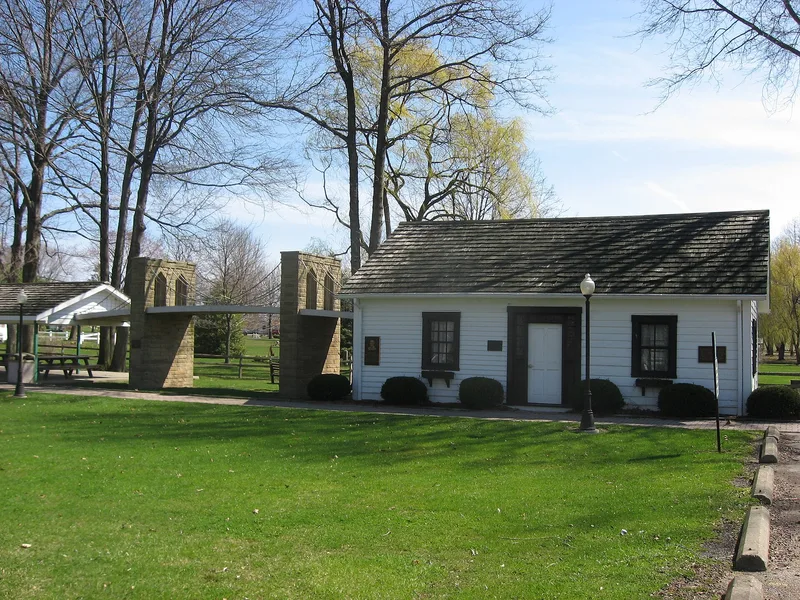
Saxonburg, in Butler County, Pennsylvania, is the setting for a house built between about 1832 and 1835 and a one-story frame shop of 1841, both associated with John Augustus Roebling. Roebling, a civil engineer born in Germany in 1806, settled here after emigrating with a group of family members. While working on state canal projects, he developed a method of stranding wires into a stronger, thinner cable to replace hemp cable used on canals and railroads. He perfected the process at his Saxonburg shop in 1841. The house is a two-story structure with a central hall, later altered with aluminum siding and a rear addition of about 1904. The shop was moved 150 feet in 1974 because of traffic and drainage problems but remains on its original lot. The buildings are not regarded as architecturally outstanding; their importance rests on the stranded cable developed within them, which later shaped suspension bridges and transportation systems.
Significance in brief: The nomination argues that the house and shop gain their significance from Roebling's development of stranded steel cable at his shop in Saxonburg in 1841. The buildings are not described as architecturally outstanding, but the cable process had far-reaching effects on transportation in the United States and abroad.
Machine-generated summary. This summary was generated by a language model from the official nomination document and has not been reviewed line by line by an editor. It may contain errors. Check the source document before relying on any detail. Source: nomination document (PDF) · National Archives catalog entry. NRHP reference 76001610, listed November 13, 1976. Summary generated October 2026 (model claude-haiku-5-5, prompt v1.1-2026-10-29, confidence medium).
Key facts
| Address | Rebecca and Main Sts., Saxonburg |
|---|---|
| County | Butler County |
| Listed | November 13, 1976 |
| Reference number | 76001610 |
| Resource type | Building |
| Period of significance | c. 1835 |
| Criteria |
|
| Areas of significance | Engineering, Transportation, Architecture |
| Level of significance | Local |
| Status (as stated in the nomination) | The shop was moved 150 feet in 1974 but remains on its original lot; a 1974 shop note is recorded. |
| Acreage | 1.3 |
| Within district | Saxonburg Historic District |
| Coordinates | 40.75084, -79.81049 (NPS GIS) |
What listing means for this property
National Register listing is honorary for a privately owned home: it does not by itself restrict what an owner may do with their own money, and it does not require public access. Restrictions come from local landmark or historic-district ordinances, which are separate (how they differ).
Owner-occupied houses are not eligible for the 20% federal rehabilitation tax credit, which applies to income-producing buildings, but many states offer credits for homeowners. Listing also opens the door to preservation easements and to buying a plaque. Start with what listing means for homeowners, renovating a listed house and selling one.
General information, not legal or tax advice. Rules change; confirm with your State Historic Preservation Office or a qualified adviser.
Sources and further reading
- National Park Service, National Register of Historic Places database (snapshot May 2026), reference 76001610.
- Nomination form (PDF, National Archives) — catalog entry
- Wikipedia article (used for cross-checking only; text not reproduced here)
- Wikidata Q6255383
- This listing as JSON
Last updated October 2026. Found an error? See the editorial policy for how to report it.