Yardley Historic District

Why it's listed
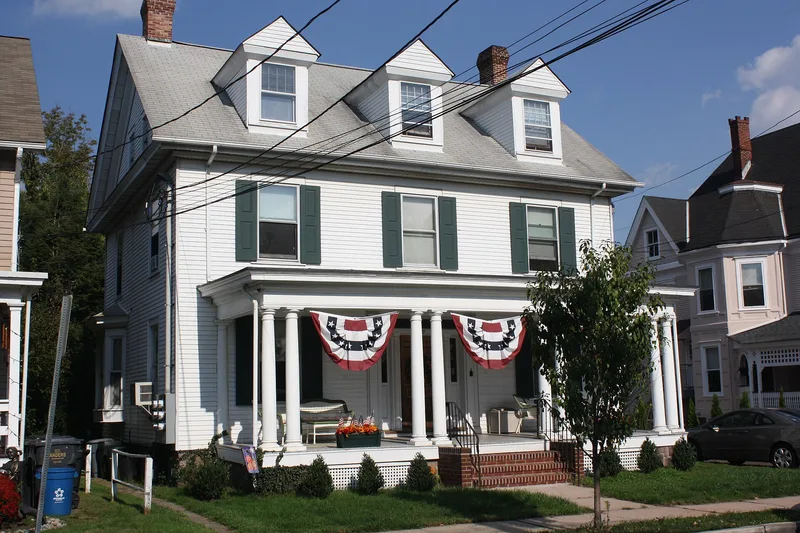
Yardley is a small borough on the west bank of the Delaware River, where a ferry crossing begun in 1722 grew into a village. Its main street and side streets hold houses and commercial buildings from the 1728 Lakeside residence through early 20th-century work. The Delaware Canal, constructed through the village from about 1830 to 1832, linked Easton to Bristol and carried mostly anthracite coal. Its mills, coal yards, boatyards, hotels and worker housing shaped the town's growth. The Bound Brook railroad branch arrived in 1876, and interurban trolleys followed in the early 20th century. Architecturally, the district holds a large group of Gothic Revival and Carpenter Gothic buildings, including the Yardley Public Library and St. Andrew's Episcopal Church, along with Federal, Georgian and Queen Anne houses. Most of its 215 resources are contributing, and the district retains its historic setting, materials and design.
Significance in brief: The nomination argues the district is significant under Criterion A for transportation, because the Delaware Canal, built through the village c. 1830 to 1832, drove its economic development. It is significant under Criterion C for architecture, with examples ranging from Georgian and Federal to Gothic Revival, Carpenter Gothic, Queen Anne and Colonial Revival styles. Its concentration of Carpenter Gothic buildings is described as outstanding.
Machine-generated summary. This summary was generated by a language model from the official nomination document and has not been reviewed line by line by an editor. It may contain errors. Check the source document before relying on any detail. Source: nomination document (PDF) · National Archives catalog entry. NRHP reference 05000417, listed May 10, 2005. Summary generated October 2026 (model claude-haiku-5-5, prompt v1.1-2026-10-29, confidence medium).
Key facts
| Address | Roughly bounded by Main St., Afton Ave., Letchworth Ave., Canal St., S. Edgewater Ave., and Delaware Canal, Yardley |
|---|---|
| County | Bucks County |
| Listed | May 10, 2005 |
| Reference number | 05000417 |
| Resource type | District |
| Period of significance | C. 1728 to C. 1925 |
| Architect / builder | Martin, A. Oscar |
| Architectural style | Gothic Revival; Federal; Queen Anne; Georgian; Carpenter Gothic; Greek Revival; Stick; Italianate; Second Empire; Four Square; Colonial Revival; Bungalow/Craftsman |
| Criteria |
|
| Areas of significance | Transportation, Architecture |
| Level of significance | Local |
| Status (as stated in the nomination) | Most buildings are in use; several 19th-century houses have been converted to offices and shops, and the Delaware Canal is now a recreational trail within Delaware Canal State Park. |
| Acreage | 65.2 |
| Coordinates | 40.24222, -74.83546 (NPS GIS) |
What listing means for this property
This is a historic district. Buildings within its boundary are either contributing (they add to the district's significance) or non-contributing. Owners of contributing income-producing buildings can claim the 20% federal rehabilitation tax credit; homeowners should look at state credits. National Register districts impose no design review by themselves; a local historic district ordinance, if one exists, does (the difference explained).
General information, not legal or tax advice. Rules change; confirm with your State Historic Preservation Office or a qualified adviser.
Sources and further reading
- National Park Service, National Register of Historic Places database (snapshot May 2026), reference 05000417.
- Nomination form (PDF, National Archives) — catalog entry
- Wikipedia article (used for cross-checking only; text not reproduced here)
- Wikidata Q84973917
- This listing as JSON
Last updated October 2026. Found an error? See the editorial policy for how to report it.