Buckmanville Historic District

Why it's listed
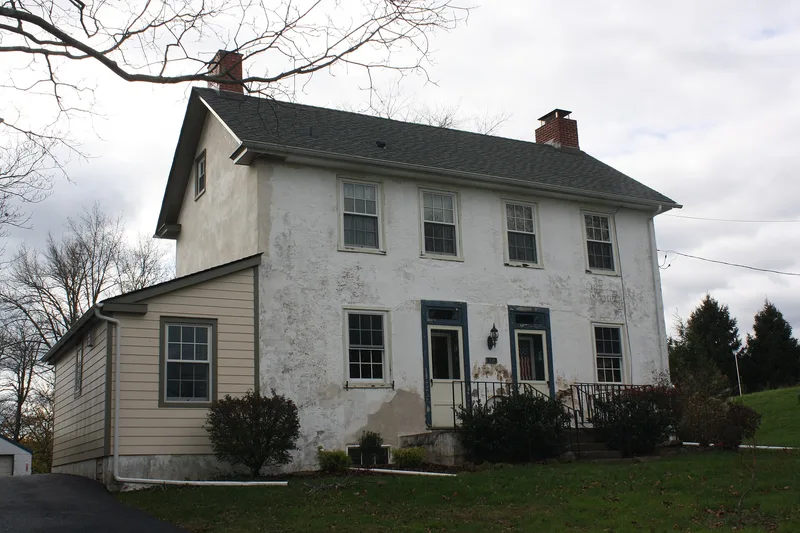
Buckmanville is a small village of frame houses, stone farmhouses and outbuildings along the west side of Street Road in Upper Makefield Township, Bucks County. Most of its buildings date from about 1820 to 1875 and stand close to the road on narrow village lots with uniform setbacks. William H. Ellis began selling village lots in the 1840s, and George Buckman established a plow manufactory here in the 1840s, producing plows designed by Benjamin Wiggins. Barclay J. Smith later acquired most of the village lots, ran a general store that housed the post office, and built many of the surviving houses, including a double house dated to about 1863. The buildings show vernacular Federal, Greek Revival, Gothic Revival and Italianate features, such as eyebrow windows, paired doors and bracketed cornices. The district is regarded as a cohesive example of a mid-nineteenth-century rural hamlet. Its architecture and layout are the reasons for its listing.
Significance in brief: The nomination argues the district is a visually distinct collection of vernacular buildings in the Federal, Greek Revival, Gothic Revival and Italianate styles, typical of the region between the 1820s and 1870s. It also ties the village's development to George Buckman's plow manufactory and to Barclay J. Smith, who owned most village lots and built many of the buildings.
Machine-generated summary. This summary was generated by a language model from the official nomination document and has not been reviewed line by line by an editor. It may contain errors. Check the source document before relying on any detail. Source: nomination document (PDF) · National Archives catalog entry. NRHP reference 02000224, listed March 20, 2002. Summary generated October 2026 (model claude-haiku-5-5, prompt v1.1-2026-10-29, confidence medium).
Key facts
| Address | Street Rd. bet. Windy Bush and Buckmanville Rds., Upper Makefield |
|---|---|
| County | Bucks County |
| Listed | March 20, 2002 |
| Reference number | 02000224 |
| Resource type | District |
| Period of significance | 1820-1875 |
| Architectural style | Federal; Greek Revival; Gothic Revival; Italianate (vernacular examples) |
| Criteria |
|
| Areas of significance | Architecture |
| Level of significance | Local |
| Status (as stated in the nomination) | Village is now residential; the general store and post office burned between 1924 and 1931, and one primary building is gone. |
| Acreage | 30 |
| Coordinates | 40.31545, -74.97637 (NPS GIS) |
What listing means for this property
This is a historic district. Buildings within its boundary are either contributing (they add to the district's significance) or non-contributing. Owners of contributing income-producing buildings can claim the 20% federal rehabilitation tax credit; homeowners should look at state credits. National Register districts impose no design review by themselves; a local historic district ordinance, if one exists, does (the difference explained).
General information, not legal or tax advice. Rules change; confirm with your State Historic Preservation Office or a qualified adviser.
Sources and further reading
- National Park Service, National Register of Historic Places database (snapshot May 2026), reference 02000224.
- Nomination form (PDF, National Archives) — catalog entry
- Wikipedia article (used for cross-checking only; text not reproduced here)
- Wikidata Q4983406
- This listing as JSON
Last updated October 2026. Found an error? See the editorial policy for how to report it.