Isett, Jacob, House and Store
Also known as: Arch Spring Farm

Why it's listed
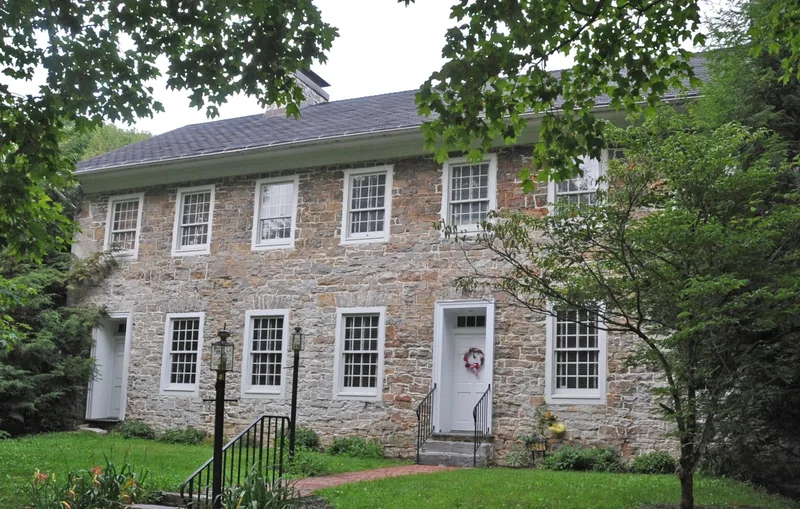
Limestone house and store built by Jacob Isett beside Arch Spring in the northeast end of Sinking Valley, Blair County. The store was built in 1799 and the house is dated 1805 by a date stone under its north gable. The seven-bay, two-and-one-half-story house is a vernacular Georgian design with walls about two feet thick, and the store shows a strong Federal influence. Outbuildings date from about 1870, including a summer kitchen, barn, stable and implement shed. Isett established a house, saw mill, grist mill and store on the site beginning around 1788, and the complex grew into a small milling hamlet in the nineteenth century. The property is significant for its link to the settlement of Sinking Valley, which was once a frontier lead-mining area, and for its locally important stone and rural vernacular buildings. Fires in 1920 and 1965 altered parts of the house and store, though the exterior features remain largely original.
Significance in brief: The nomination argues the complex is the most intact remnant of an early nineteenth century mill seat in the valley, associated with the settlement of Sinking Valley. It also presents the house and store as locally important examples of late eighteenth or early nineteenth century stone buildings influenced by the Georgian and Federal styles, and as a locally significant group of rural vernacular architecture.
Machine-generated summary. This summary was generated by a language model from the official nomination document and has not been reviewed line by line by an editor. It may contain errors. Check the source document before relying on any detail. Source: nomination document (PDF) · National Archives catalog entry. NRHP reference 97000290, listed March 28, 1997. Summary generated October 2026 (model claude-haiku-5-5, prompt v1.1-2026-10-29, confidence medium).
Key facts
| Address | PA 1013, .3 mi. S of jct. with PA 1015, Tyrone Township, Arch Spring |
|---|---|
| County | Blair County |
| Listed | March 28, 1997 |
| Reference number | 97000290 |
| Resource type | Building |
| Period of significance | 1799-1870 |
| Architectural style | Georgian |
| Criteria |
|
| Areas of significance | Architecture, Exploration/Settlement |
| Level of significance | Local |
| Status (as stated in the nomination) | Portions of the house and store were damaged by fires in 1920 and 1965; the house's north section was repaired, and the store's second floor and roof were repaired. |
| Acreage | 8 |
| Coordinates | 40.60444, -78.20654 (NPS GIS) |
What listing means for this property
National Register listing is honorary for a privately owned home: it does not by itself restrict what an owner may do with their own money, and it does not require public access. Restrictions come from local landmark or historic-district ordinances, which are separate (how they differ).
Owner-occupied houses are not eligible for the 20% federal rehabilitation tax credit, which applies to income-producing buildings, but many states offer credits for homeowners. Listing also opens the door to preservation easements and to buying a plaque. Start with what listing means for homeowners, renovating a listed house and selling one.
General information, not legal or tax advice. Rules change; confirm with your State Historic Preservation Office or a qualified adviser.
Sources and further reading
- National Park Service, National Register of Historic Places database (snapshot May 2026), reference 97000290.
- Nomination form (PDF, National Archives) — catalog entry
- Wikipedia article (used for cross-checking only; text not reproduced here)
- Wikidata Q6118787
- This listing as JSON
Last updated October 2026. Found an error? See the editorial policy for how to report it.