Weiser, Conrad, House

Why it's listed
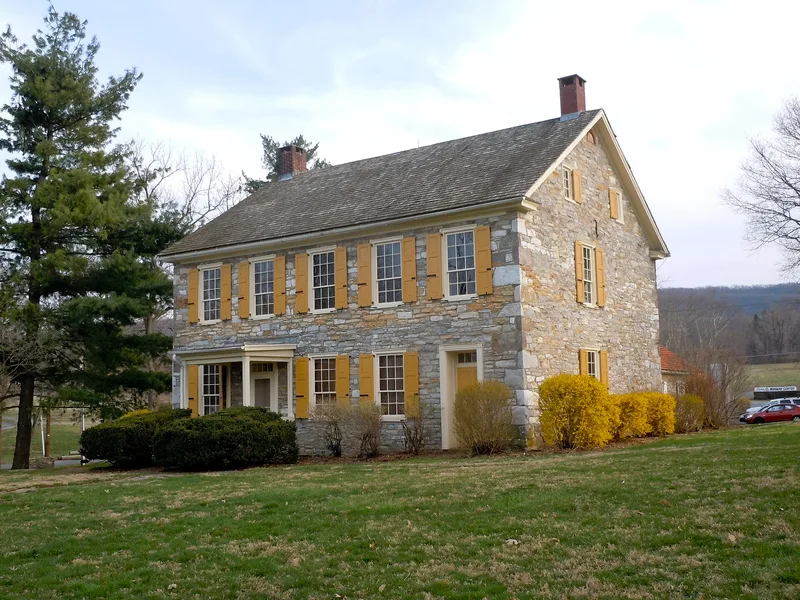
Built by Johann Conrad Weiser in 1729 in the Tulpehocken Valley near present-day Womelsdorf, this rectangular stone farmhouse has a shingled gable roof and chimneys at each gable end. Its single first-floor room served as kitchen, dining room and parlour, with the attic used for sleeping, and a large south fireplace with a bake oven. The north end was added in 1751 for a growing family. Weiser held an important role in colonial Pennsylvania as an interpreter and diplomat. In 1737 he was sent to the Iroquois Onondaga Council to call off a war between Virginians and the Iroquois, and in 1748 he won the western tribes at the Treaty of Logstown. He also served as Lieutenant-Colonel in the First Battalion of the Pennsylvania Regiment and as the first president judge of Berks County. The house was restored around 1926. A stone springhouse-smokehouse built by Weiser stands nearby, and the Weiser family graves lie in the park.
Significance in brief: The nomination argues that Weiser was the principal colonial agent in arranging and carrying out Indian policy in Pennsylvania, helping keep the western frontier peaceful in the two decades before the French and Indian War. It credits him with securing the Iroquois Six Nations' peaceful relations with the colonists through that war.
Machine-generated summary. This summary was generated by a language model from the official nomination document and has not been reviewed line by line by an editor. It may contain errors. Check the source document before relying on any detail. Source: nomination document (PDF) · National Archives catalog entry. NRHP reference 66000646, listed October 15, 1966. Summary generated October 2026 (model claude-haiku-5-5, prompt v1.1-2026-10-29, confidence medium).
Key facts
| Address | 2 mi. E of Womelsdorf, Womelsdorf |
|---|---|
| County | Berks County |
| Listed | October 15, 1966 |
| Reference number | 66000646 |
| Resource type | Building |
| Period of significance | 18th Century |
| Architect / builder | Johann Conrad Weiser (builder) |
| Areas of significance | Native American, Politics/Government |
| Level of significance | National |
| National Historic Landmark | Yes, designated October 9, 1960 |
| Status (as stated in the nomination) | Restored c. 1926 after the house burned; maintained as a commemorative museum by the Pennsylvania Historical and Museum Commission. |
| Acreage | 26 |
| Coordinates | 40.35945, -76.17308 (NPS GIS) |
What listing means for this property
National Register listing is honorary for a privately owned home: it does not by itself restrict what an owner may do with their own money, and it does not require public access. Restrictions come from local landmark or historic-district ordinances, which are separate (how they differ).
Owner-occupied houses are not eligible for the 20% federal rehabilitation tax credit, which applies to income-producing buildings, but many states offer credits for homeowners. Listing also opens the door to preservation easements and to buying a plaque. Start with what listing means for homeowners, renovating a listed house and selling one.
General information, not legal or tax advice. Rules change; confirm with your State Historic Preservation Office or a qualified adviser.
Sources and further reading
- National Park Service, National Register of Historic Places database (snapshot May 2026), reference 66000646.
- Nomination form (PDF, National Archives) — catalog entry
- Wikipedia article (used for cross-checking only; text not reproduced here)
- Wikidata Q5162625
- This listing as JSON
Last updated October 2026. Found an error? See the editorial policy for how to report it.