Mary Ann Furnace Historic District
Also known as: Trexler's Furnace

Why it's listed
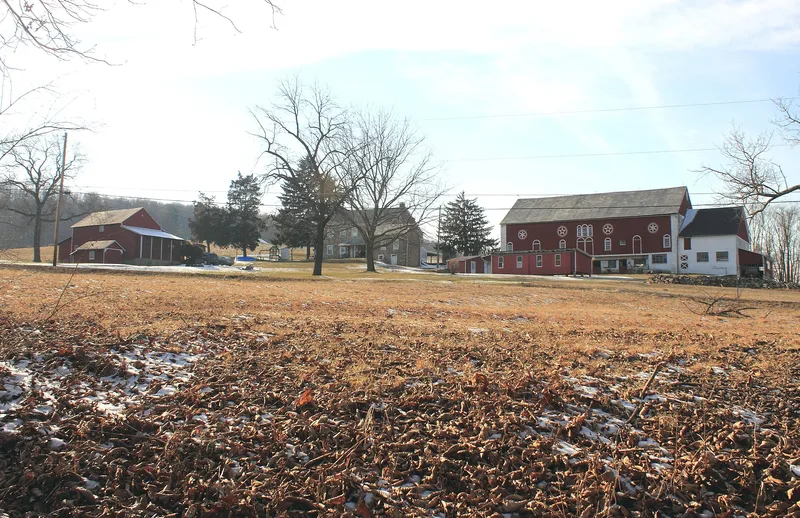
Mary Ann Furnace, an iron plantation in Longswamp Township in Berks County, Pennsylvania, was erected in 1789 by Jacob Lesher beside the Little Lehigh Creek. Its operation passed to his son-in-law Reuben Trexler in 1808 and then to Trexler's son Horatio in 1837, who ran it until the furnace closed in 1869. The surviving complex includes the collapsed furnace stack, a stone manager's house with Federal-style entrance frontispieces, an office building, a bank barn, a dated 1854 blacksmith shop, a charcoal house, a stone dam and a worker's house. Reuben Trexler is credited with making the first anthracite stoves in Pennsylvania around 1820, and the furnace later cast the Lehigh Coal Stove until 1857. The district is valued for its early role in the iron industry of eastern Pennsylvania and for the integrity of its buildings, which together show the layout of the original plantation.
Significance in brief: The district is nominated under Criterion A for its association with the early iron industry in eastern Pennsylvania and as a good example of a modest iron plantation. It is also nominated under Criterion C for its architecture, particularly the Federal-style entrance frontispieces of the manager's house and the bank barn. The blacksmith shop is described as rarely found in such original condition.
Machine-generated summary. This summary was generated by a language model from the official nomination document and has not been reviewed line by line by an editor. It may contain errors. Check the source document before relying on any detail. Source: nomination document (PDF) · National Archives catalog entry. NRHP reference 91001141, listed September 6, 1991. Summary generated October 2026 (model claude-haiku-5-5, prompt v1.1-2026-10-29, confidence high).
Key facts
| Address | Centennial Rd. SE of Longswamp, Longswamp Township, Longswamp |
|---|---|
| County | Berks County |
| Listed | September 6, 1991 |
| Reference number | 91001141 |
| Resource type | District |
| Period of significance | 1789-1869 |
| Architectural style | other: 99 iron furnace |
| Criteria |
|
| Areas of significance | Industry, Architecture |
| Level of significance | State |
| Status (as stated in the nomination) | The furnace closed in 1869 and the property was afterwards converted to agricultural use; it is still being farmed. |
| Acreage | 9 |
| Coordinates | 40.48473, -75.64809 (NPS GIS) |
What listing means for this property
This is a historic district. Buildings within its boundary are either contributing (they add to the district's significance) or non-contributing. Owners of contributing income-producing buildings can claim the 20% federal rehabilitation tax credit; homeowners should look at state credits. National Register districts impose no design review by themselves; a local historic district ordinance, if one exists, does (the difference explained).
General information, not legal or tax advice. Rules change; confirm with your State Historic Preservation Office or a qualified adviser.
Sources and further reading
- National Park Service, National Register of Historic Places database (snapshot May 2026), reference 91001141.
- Nomination form (PDF, National Archives) — catalog entry
- Wikipedia article (used for cross-checking only; text not reproduced here)
- Wikidata Q6778873
- This listing as JSON
Last updated October 2026. Found an error? See the editorial policy for how to report it.