Hamburg Historic District

Why it's listed
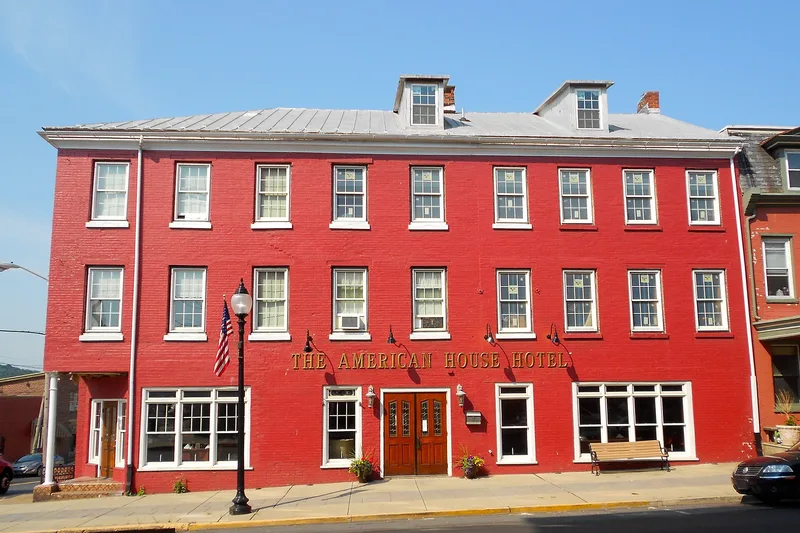
Hamburg Borough, on the Schuylkill River at the foot of Blue Mountain in Berks County, contains a historic district of about 100 acres built mainly between 1811 and 1958. The district holds 582 buildings, 435 of them contributing, most two or three stories and brick. Its streets radiate from the crossing of State and Fourth Streets, where the town's earliest buildings stand. Settled in 1772 and laid out by Martin Kaercher Jr. in 1779, Hamburg grew with the Centre Turnpike, the Schuylkill Canal opened in 1824, and the Philadelphia and Reading Railroad, which arrived in 1842. Its commercial core, banks and varied industries gave it a regional role in trade. The district is significant for its commercial development and for its concentration of 19th- and early 20th-century architecture, including Italianate, Queen Anne and Second Empire houses.
Significance in brief: The nomination argues the district illustrates the growth of a small crossroads village into a regional commercial center, with its business district and banking and trade functions serving northern Berks County. It also presents the district as a cohesive concentration of 19th- and 20th-century architectural styles, with a few architect-designed buildings and many vernacular examples. The district is said to retain its historic appearance and setting largely unchanged.
Machine-generated summary. This summary was generated by a language model from the official nomination document and has not been reviewed line by line by an editor. It may contain errors. Check the source document before relying on any detail. Source: nomination document (PDF) · National Archives catalog entry. NRHP reference 10000398, listed June 28, 2010. Summary generated October 2026 (model claude-haiku-5-5, prompt v1.1-2026-10-29, confidence medium).
Key facts
| Address | Roughly bounded by Franklin, Windsor, Walnut and Second Sts, Quince, Primrose, peach and Plum Alleys and Mill Creek, Hamburg |
|---|---|
| County | Berks County |
| Listed | June 28, 2010 |
| Reference number | 10000398 |
| Resource type | District |
| Period of significance | 1811-1958 |
| Architectural style | Italianate, Queen Anne, Gothic Revival, Late Victorian, Second Empire, Georgian, Federal, Greek Revival, Classical Revival, Commercial Style, Colonial Revival, Craftsman Bungalow, Art Deco |
| Criteria |
|
| Areas of significance | Commerce, Architecture |
| Level of significance | Local |
| Status (as stated in the nomination) | The district retains many storefronts occupied by long-term and new businesses, and the borough has been pursuing revitalization since 2001. |
| Acreage | 100.3 |
| Coordinates | 40.55483, -75.98117 (NPS GIS) |
What listing means for this property
This is a historic district. Buildings within its boundary are either contributing (they add to the district's significance) or non-contributing. Owners of contributing income-producing buildings can claim the 20% federal rehabilitation tax credit; homeowners should look at state credits. National Register districts impose no design review by themselves; a local historic district ordinance, if one exists, does (the difference explained).
General information, not legal or tax advice. Rules change; confirm with your State Historic Preservation Office or a qualified adviser.
Sources and further reading
- National Park Service, National Register of Historic Places database (snapshot May 2026), reference 10000398.
- Nomination form (PDF, National Archives) — catalog entry
- Wikipedia article (used for cross-checking only; text not reproduced here)
- Wikidata Q5644303
- This listing as JSON
Last updated October 2026. Found an error? See the editorial policy for how to report it.