Bishop, John, House

Why it's listed
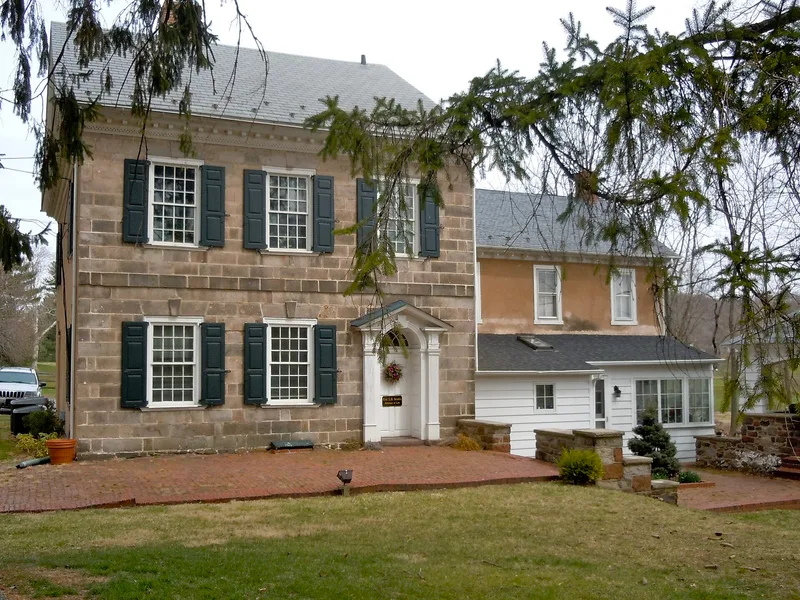
Built of stone in the mid-18th century beside Antietam Creek in Exeter Township, the John Bishop House is a two and one-half story Georgian dwelling with a three-bay cut-stone south facade. Its interior is noted for a panelled front parlor with flanking cupboards, a Troy dado, and marble-sheathed fireplace, along with an open scissor staircase rising three stories. John Bishop acquired the nearby gristmill and surrounding acreage in 1769, and he later managed Hopewell Furnace and held property in Berks County and Virginia. He also helped fund local militia during the Revolution and served in the General Assembly from 1781 to 1784. The house is regarded as closely related to Philadelphia and Germantown residences, particularly Cliveden, in its detailing and proportion. Its woodwork and stair are the main reasons it is considered architecturally important.
Significance in brief: The nomination argues the house is an intact example of colonial Georgian architecture in the Palladian style, with an unusually well-preserved interior including a panelled front parlor and fan-lighted entrance. It also links the house to John Bishop, an early Berks County figure involved in local militia support, the state legislature, and his management of Hopewell Furnace. The architectural comparisons to Philadelphia and Germantown buildings are offered as further support.
Machine-generated summary. This summary was generated by a language model from the official nomination document and has not been reviewed line by line by an editor. It may contain errors. Check the source document before relying on any detail. Source: nomination document (PDF) · National Archives catalog entry. NRHP reference 85001390, listed June 27, 1985. Summary generated October 2026 (model claude-haiku-5-5, prompt v1.1-2026-10-29, confidence medium).
Key facts
| Address | Perkiomen Ave., Reading |
|---|---|
| County | Berks County |
| Listed | June 27, 1985 |
| Reference number | 85001390 |
| Resource type | Building |
| Period of significance | c. 1769-1800 |
| Architectural style | Palladian Georgian |
| Criteria |
|
| Areas of significance | Commerce, Architecture |
| Level of significance | Local |
| Status (as stated in the nomination) | The property is described as altered, with a later east wing and enclosed porch, and the adjoining golf course surrounds it; the form does not state its current use. |
| Acreage | 1 |
| Within district | Reading Country Club |
| Coordinates | 40.30072, -75.84848 (NPS GIS) |
What listing means for this property
National Register listing is honorary for a privately owned home: it does not by itself restrict what an owner may do with their own money, and it does not require public access. Restrictions come from local landmark or historic-district ordinances, which are separate (how they differ).
Owner-occupied houses are not eligible for the 20% federal rehabilitation tax credit, which applies to income-producing buildings, but many states offer credits for homeowners. Listing also opens the door to preservation easements and to buying a plaque. Start with what listing means for homeowners, renovating a listed house and selling one.
General information, not legal or tax advice. Rules change; confirm with your State Historic Preservation Office or a qualified adviser.
Sources and further reading
- National Park Service, National Register of Historic Places database (snapshot May 2026), reference 85001390.
- Nomination form (PDF, National Archives) — catalog entry
- Wikipedia article (used for cross-checking only; text not reproduced here)
- Wikidata Q6222007
- This listing as JSON
Last updated October 2026. Found an error? See the editorial policy for how to report it.