St. John the Baptist Ukranian Catholic Church

Why it's listed
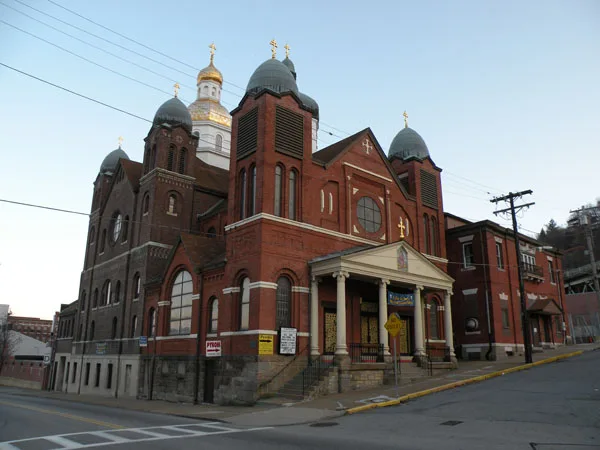
Built in 1895 on Pittsburgh's South Side, the St. John the Baptist Ukrainian Catholic Church is a one-story brick and stone building set on a sloping site, with a rusticated ground story forming its base. Its plan is a Greek cross with a central dome and smaller domes over the facade and nave, all capped with turquoise onion domes. Classical details include a pedimented portico on Byzantine Ionic columns, dentils on the entablature and festoons on the drum cornice. A two-story brick and stone addition was built in 1919. The nomination treats the church as the principal architectural statement of the Slavic immigrants who arrived in the South Side from about 1863, a community that had little effect on domestic building. Its domes contrast with the mills and factory chimneys around it, and it is regarded as the most distinctive ethnic church in the city.
Significance in brief: The nomination argues the church is significant as an expression of the Slavic immigrant community that settled the South Side from about 1863, when churches were the main place these groups could express themselves architecturally. It also argues the building adds an exotic, Eastern note to Pittsburgh's industrial landscape and represents the immigrant contribution to the city's growth.
Machine-generated summary. This summary was generated by a language model from the official nomination document and has not been reviewed line by line by an editor. It may contain errors. Check the source document before relying on any detail. Source: nomination document (PDF) · National Archives catalog entry. NRHP reference 74001747, listed October 29, 1974. Summary generated October 2026 (model claude-haiku-5-5, prompt v1.1-2026-10-29, confidence medium).
Key facts
| Address | 109 S. Carson St., Pittsburgh |
|---|---|
| County | Allegheny County |
| Listed | October 29, 1974 |
| Reference number | 74001747 |
| Resource type | Building |
| Period of significance | 1850-1899 |
| Architectural style | Russian interpretation of Classicism, Byzantine multi-domed church |
| Criteria |
|
| Areas of significance | Architecture, Religion, Social History |
| Level of significance | Local |
| Status (as stated in the nomination) | Original site; described as in good condition in the description section |
| Acreage | 1 |
| Coordinates | 40.42844, -79.99219 (NPS GIS) |
What listing means for this property
Religious properties are listed for their architectural or historical significance, not their religious use. Listing is honorary and does not restrict the congregation's use of the building. The federal rehabilitation credit is generally unavailable unless part of the building is income-producing; some state programmes and preservation grants do cover religious buildings. Federal funding or permits trigger Section 106 review.
General information, not legal or tax advice. Rules change; confirm with your State Historic Preservation Office or a qualified adviser.
Sources and further reading
- National Park Service, National Register of Historic Places database (snapshot May 2026), reference 74001747.
- Nomination form (PDF, National Archives) — catalog entry
- Wikipedia article (used for cross-checking only; text not reproduced here)
- Wikidata Q7588976
- This listing as JSON
Last updated October 2026. Found an error? See the editorial policy for how to report it.