Allegheny Observatory

Why it's listed
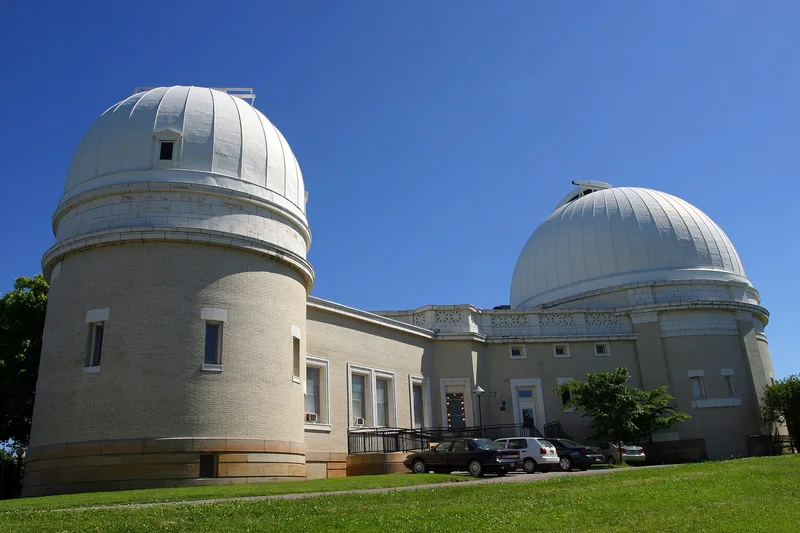
Built on the Northside of Pittsburgh, the Allegheny Observatory has a classical layout with a large rectangular block, a pedimented entrance supported by Doric columns, and three large domes that house its telescopes. Architect Thorsten E. Billquist designed the building after an 1896 competition, and the cornerstone was laid on October 20, 1900, on land donated by David E. Parks. The observatory's scientific reputation rests on its instruments. The original 13-inch Fitz-Clark refractor was used by Samuel Pierpont Langley to study solar energy and by James Keeler to show that Saturn's rings are made of particles. The 30-inch Thaw astrometric refractor, completed in 1912-13, has measured the distances to more than 2,500 stars and is one of the few instruments capable of searching for planets around other stars. The observatory also trained generations of student astronomers.
Significance in brief: The nomination argues the observatory is significant for its scientific work, centred on its telescopes and the astronomers who used them. It cites the 30-inch Thaw astrometric refractor as the most successful telescope of its kind, used to measure distances to over 2,500 stars. It also credits the observatory's research on the Sun, Saturn's rings and double and triple stars.
Machine-generated summary. This summary was generated by a language model from the official nomination document and has not been reviewed line by line by an editor. It may contain errors. Check the source document before relying on any detail. Source: nomination document (PDF) · National Archives catalog entry. NRHP reference 79002157, listed June 22, 1979. Summary generated October 2026 (model claude-haiku-5-5, prompt v1.1-2026-10-29, confidence medium).
Key facts
| Address | 159 Riverview Ave., Pittsburgh |
|---|---|
| County | Allegheny County |
| Listed | June 22, 1979 |
| Reference number | 79002157 |
| Resource type | Building |
| Period of significance | 1900-1924 |
| Architect / builder | T. E. Billquist (architect) |
| Architectural style | Classical |
| Criteria |
|
| Areas of significance | Science, Architecture |
| Level of significance | State |
| Status (as stated in the nomination) | Continues to serve the University of Pittsburgh and the public, with active research; the Thaw and Keeler telescopes remain in use. |
| Acreage | 207 |
| Within district | Riverview Park |
| Coordinates | 40.48115, -80.02179 (NPS GIS) |
What listing means for this property
National Register listing is honorary: it recognises significance and does not restrict what a private owner may do without federal money or permits. It unlocks the 20% federal rehabilitation tax credit for income-producing buildings, state credits in many states, and Section 106 review when federal agencies are involved. See what listing means in practice.
General information, not legal or tax advice. Rules change; confirm with your State Historic Preservation Office or a qualified adviser.
Sources and further reading
- National Park Service, National Register of Historic Places database (snapshot May 2026), reference 79002157.
- Nomination form (PDF, National Archives) — catalog entry
- Wikipedia article (used for cross-checking only; text not reproduced here)
- Wikidata Q549937
- This listing as JSON
Last updated October 2026. Found an error? See the editorial policy for how to report it.