Darrow, Clarence, Octagon House

Why it's listed
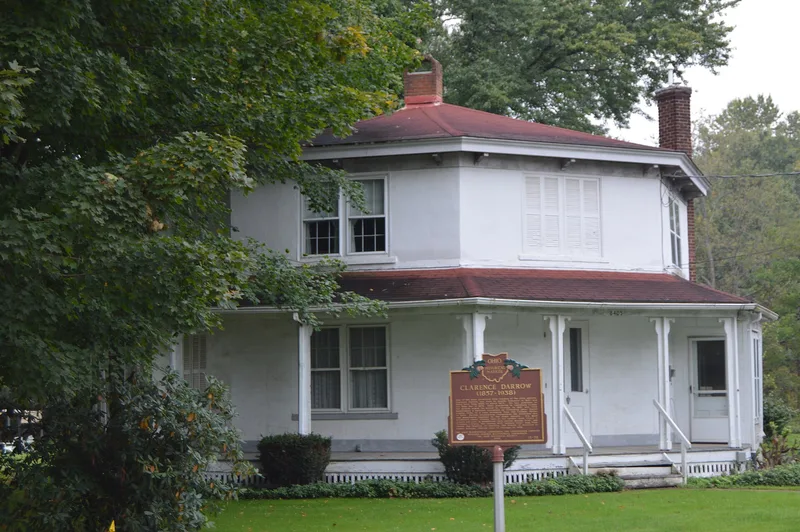
Built about 1850, this octagonal frame house in Kinsman, Ohio, has two stories, seven rooms and a single-story open porch wrapping seven of its sides. Its main historical link is to Clarence Darrow, the trial lawyer, whose family lived there from about 1864. Darrow spent nine formative years in the house before leaving Ohio in 1873, attended a nearby academy, and staged mock trials with local boys in a barn. Although he claimed in his autobiography to have been born here, local tradition places his birth in nearby Farmdale. The house has also been wrongly called an underground railroad station. Among more than 20 remaining Octagon-style houses in Ohio, it is considered architecturally modest, but it is one of only two surviving landmarks tied to Darrow. Original fireplaces, mantels, cupboards and woodwork remain, though the stairway and front door were moved to the east side. The exterior was decaying quickly when nominated, and the structure was described as in jeopardy.
Significance in brief: The house is notable as one of two landmarks in the nation intimately associated with lawyer Clarence Darrow, who lived here as a boy from about 1864 until 1873. The nomination admits it is one of the least distinguished of the more than 20 Octagon-style houses remaining in Ohio. It rejects the folklore that it was an underground railroad station.
Machine-generated summary. This summary was generated by a language model from the official nomination document and has not been reviewed line by line by an editor. It may contain errors. Check the source document before relying on any detail. Source: nomination document (PDF) · National Archives catalog entry. NRHP reference 71001025, listed September 10, 1971. Summary generated October 2026 (model claude-sonnet-5-5, prompt v1.0-2026-10-29, confidence medium).
Key facts
| Address | OH 5 and 7, Kinsman |
|---|---|
| County | Trumbull County |
| Listed | September 10, 1971 |
| Reference number | 71001025 |
| Resource type | Building |
| Period of significance | 1850 |
| Architectural style | Octagon |
| Areas of significance | Law |
| Level of significance | State |
| Status (as stated in the nomination) | Exterior in deteriorating condition; occupied as a private residence and described as in jeopardy. It served as a tourist home in the 1960s. |
| Acreage | 0.9 |
| Coordinates | 41.44975, -80.58450 (NPS GIS) |
What listing means for this property
National Register listing is honorary for a privately owned home: it does not by itself restrict what an owner may do with their own money, and it does not require public access. Restrictions come from local landmark or historic-district ordinances, which are separate (how they differ).
Owner-occupied houses are not eligible for the 20% federal rehabilitation tax credit, which applies to income-producing buildings, but many states offer credits for homeowners. Listing also opens the door to preservation easements and to buying a plaque. Start with what listing means for homeowners, renovating a listed house and selling one.
General information, not legal or tax advice. Rules change; confirm with your State Historic Preservation Office or a qualified adviser.
Sources and further reading
- National Park Service, National Register of Historic Places database (snapshot May 2026), reference 71001025.
- Nomination form (PDF, National Archives) — catalog entry
- Wikipedia article (used for cross-checking only; text not reproduced here)
- Wikidata Q5126461
- This listing as JSON
Last updated October 2026. Found an error? See the editorial policy for how to report it.